 Art
Art
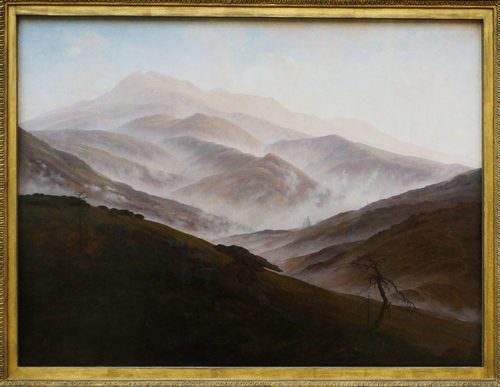
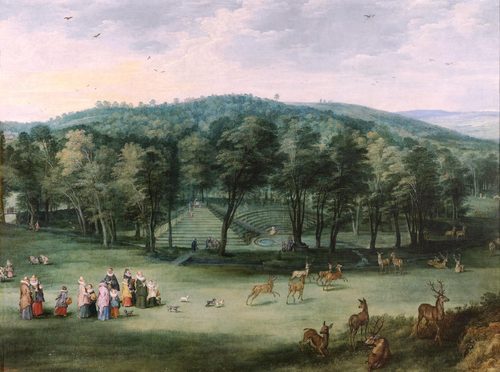
Atmospheric perspective, also called aerial perspective, creates the illusion of distance using color and clarity instead of converging lines. As real air fills the space between a viewer and a distant object, dust, moisture, and light scatter across that distance, so far-off mountains, trees, and buildings appear paler, cooler in color, lower in contrast, and softer in detail than anything in the foreground. Painters exploit this directly: foreground elements get warm colors, dark values, sharp edges, and fine detail, while background elements shift toward pale blue-grays with blurred, simplified shapes. Leonardo da Vinci was among the first to describe the effect precisely in his notebooks, calling it the 'perspective of disappearance.' Unlike linear perspective, atmospheric perspective needs no rulers or vanishing points — it works purely through value, saturation, and edge quality, which makes it essential for landscape painting, where a road rarely offers neat converging lines to draw depth from instead.
How artists use it
Cooling with distance
Painters shift background colors toward pale blue or violet, since scattered light in real atmosphere skews bluer over distance. A foreground boulder painted warm brown might have a near-identical shape repeated as a cool blue-gray silhouette far in the background.
Fading contrast
Value range compresses with distance: foreground objects hold strong darks and bright lights, while distant hills flatten into a narrow band of similar mid-tones. Reducing contrast alone can push an element backward even without changing its color.
Softened edges
Sharp, crisp edges belong to the foreground; distant forms get blurred or simplified outlines, since haze genuinely dissolves fine detail over distance. A single ridge might be crisply toothed up close and a smooth pale bump on the horizon.
Layered depth planes
Landscape painters often build a scene in three distinct bands — a detailed dark foreground, a mid-toned middle ground, and a pale hazy background — treating each plane with progressively less contrast and saturation to stack depth clearly.
Paired with linear perspective
Aerial and linear perspective frequently work together: a road can converge toward a vanishing point while also fading paler and bluer as it recedes, doubling the illusion of depth in a single receding element.
Independent Eastern tradition
Chinese landscape painters developed aerial perspective centuries before the Italian Renaissance, using pale ink washes and fading mountain silhouettes to suggest immense, misty distances in scroll paintings long before oil glazes did the same job in Europe.
Instant examples
Atmospheric Perspective in famous works, fast
- Distant blue mountains
- → the signature marker — far ranges read as pale blue-gray instead of their true rocky color.
- Hazy horizon line
- → the point where sky and land blur together, colors flattening into near-identical pale tones.
- Sharp foreground trees
- → crisp, dark, detailed foliage up close contrasts with soft, faded shapes farther back.
- Layered mountain ridges
- → each successive ridge is paler and lower-contrast than the one in front of it, stacking depth in bands.
- Fog over valleys
- → mist genuinely erases detail and color, so painters use it to justify soft, pale distant passages.
- Faded background figures
- → distant people or buildings rendered as flat, low-contrast smudges rather than defined forms.
The story
Painters noticed that distance changes color long before anyone wrote formal rules about it. Song dynasty Chinese landscapists such as Fan Kuan and Guo Xi were using fading ink washes to suggest misty, receding mountains by the eleventh century. In Europe, Netherlandish 'world landscape' painters like Joachim Patinir built sweeping panoramas in the early 1500s using bands of green, brown, and pale blue to push mountains back into hazy distance. Leonardo da Vinci analyzed the effect scientifically in his notebooks around 1500, describing how the density of air between viewer and object weakens color and sharpness, calling it the perspective of disappearance. The device became central to landscape painting through the Dutch Golden Age and the English Romantics; J.M.W. Turner dissolved distant mountains into near-abstract mist, and Hudson River School painters used the same fading haze to convey vast American wilderness.
The canonical examples
| Work | Artist | Date | Why it matters |
|---|---|---|---|
| Mona Lisa | Leonardo da Vinci | c. 1503–1519 | the rocky background landscape fades into pale blue-green haze behind the sitter, applying Leonardo's own theory of aerial perspective |
| Wanderer above the Sea of Fog | Caspar David Friedrich | 1818 | layered mountain ridges grow paler and flatter with each step back into the mist below the standing figure |
| The Oxbow (View from Mount Holyoke) | Thomas Cole | 1836 | the cultivated river valley recedes into a soft blue-white haze contrasted against a darker, detailed foreground ridge |
| The Harvesters | Pieter Bruegel the Elder | 1565 | distant hills and a small village fade to pale bluish tones behind the warm gold of the foreground wheat field |
| Snow Storm: Hannibal and His Army Crossing the Alps | J.M.W. Turner | 1812 | the distant mountain range dissolves almost entirely into swirling pale atmosphere, pushing depth toward abstraction |
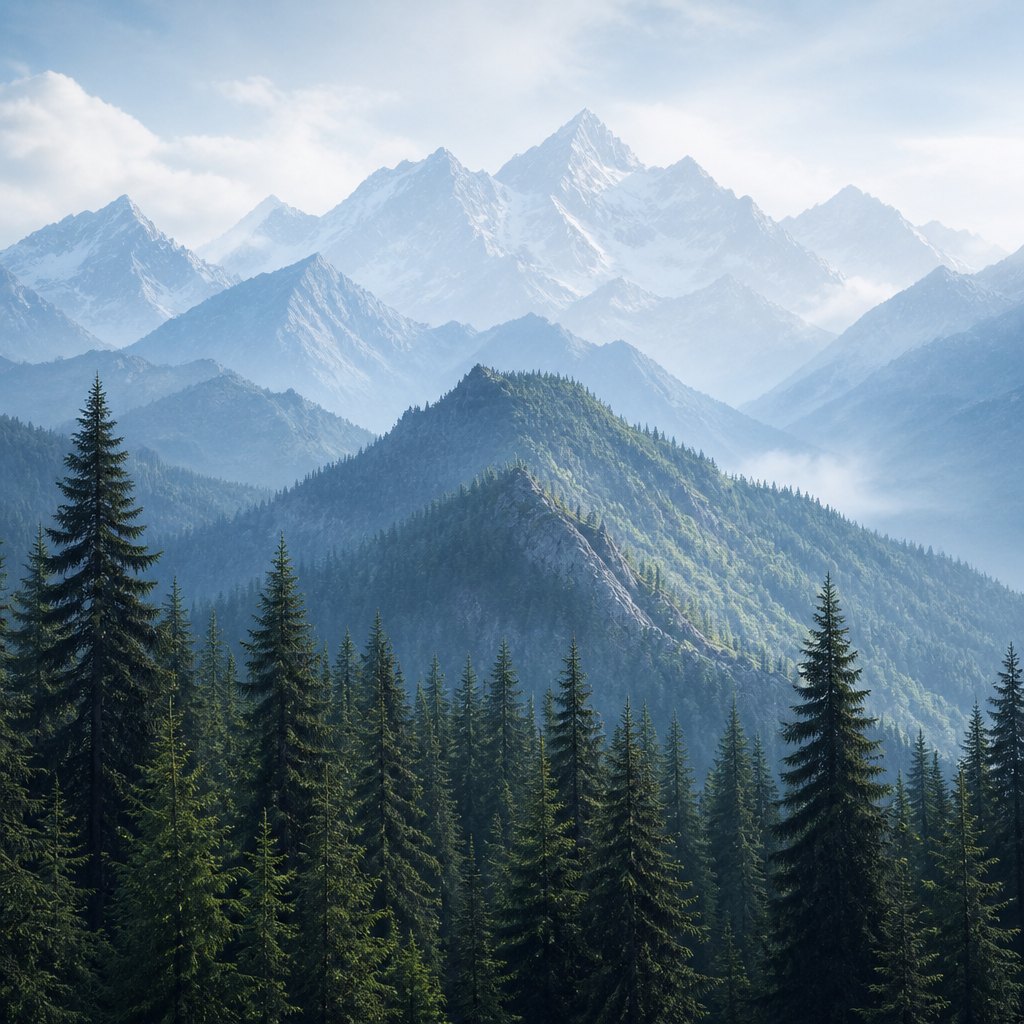 AI-generated
Try it yourself
Practice atmospheric perspective with AI
This example was generated from a prompt like: “A layered mountain landscape: a sharply detailed dark pine forest in the foreground, a softer mid-toned ridge behind it, and distant peaks fading into pale blue-white haze near the horizon, serene, wide vista.”
Open the Atmospheric Perspective Art Style generator →The concept today
Digital painters fake atmospheric perspective with a simple haze layer, desaturating and lightening anything meant to sit far back, or by adding a blue-gray gradient overlay to a background. Game engines apply real-time distance fog that automatically lightens and blurs geometry farther from the camera, both for realism and to save rendering power. Photographers see the same effect naturally on hazy days, and film matte painters still lean on fading blue tones to sell enormous painted landscapes as believable distance.
Compose your own
Divide your landscape into three zones — foreground, middle ground, and background — before you paint anything. Keep the foreground warm, dark, saturated, and sharply detailed. Push the middle ground toward slightly cooler, lower-contrast color with softer edges. Make the background pale, blue-gray, low-contrast, and nearly detail-free, letting shapes blur into simplified silhouettes. A good test: squint at your painting — the background should nearly disappear into the sky while the foreground still reads clearly. Try painting the same mountain shape three times at decreasing saturation and contrast to feel how little change is needed to push a form back into space.
Frequently asked questions
What is atmospheric perspective in art?
Atmospheric perspective, also called aerial perspective, is a technique where painters make distant objects paler, cooler in color, lower in contrast, and less detailed than foreground objects, imitating how real haze and air affect our view of far-off things.
What is the difference between linear and atmospheric perspective?
Linear perspective uses converging lines and a vanishing point to suggest depth through geometry, while atmospheric perspective uses shifts in color, contrast, and detail — no lines or vanishing points required — to suggest the same illusion of distance.
Why do distant objects look blue in paintings?
Real atmosphere scatters shorter blue wavelengths of light more than others, so anything seen through a lot of air, like a far mountain range, actually looks bluer and paler to the human eye — painters simply reproduce that real optical effect.
Who first used atmospheric perspective in painting?
Song dynasty Chinese landscape painters used fading ink washes for misty distance by the eleventh century, and in Europe Leonardo da Vinci analyzed and named the effect around 1500, calling it the perspective of disappearance.