 Art
Art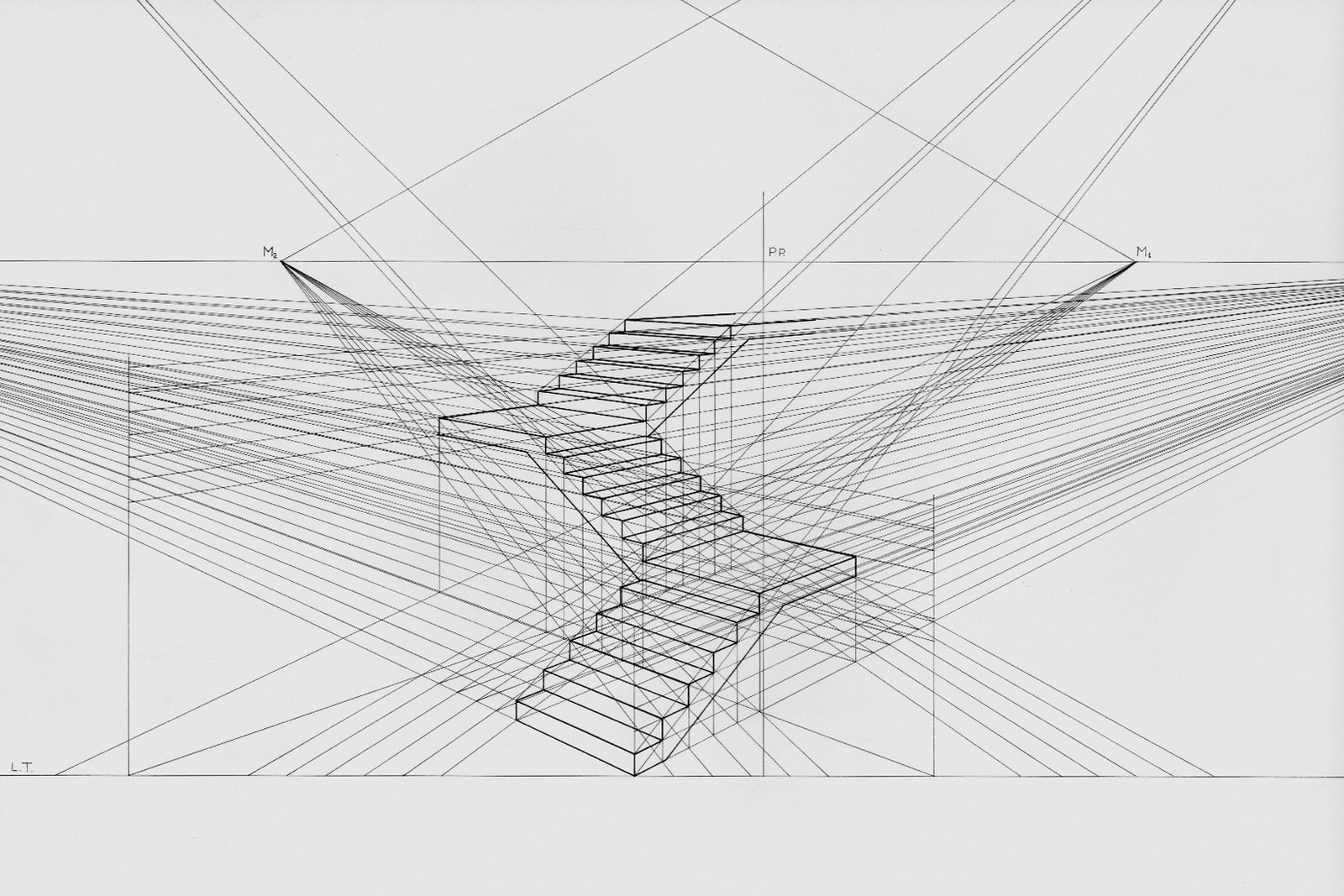
Two-point perspective is a drawing system that uses two vanishing points, both set on the horizon line, to represent an object seen at an angle rather than head-on. Instead of one set of parallel lines converging toward a single point behind the picture, two separate sets recede toward two points on opposite sides of the composition, usually far outside the frame. This is the perspective of a building corner: one wall's lines rush left, the other wall's lines rush right, and the vertical edge where they meet stays perfectly upright. Cubes, boxes, and street corners drawn this way feel far more three-dimensional than the same forms in flat one-point perspective, because the eye sees two receding faces instead of one. Architects, illustrators, and comic artists rely on it constantly for cityscapes, interiors, and product renderings, since most real-world scenes are viewed from an angle. It sits between one-point perspective, simplest and most frontal, and three-point perspective, which adds a third point above or below for extreme height.
How artists use it
Street-corner drawing
Gustave Caillebotte's Paris Street; Rainy Day (1877) shows two building facades receding toward two separate vanishing points on either side of a central lamppost, whose vertical pole stays true while the pavement lines splay outward. It's a textbook two-point corner mapped onto a real Paris intersection.
Tilted cubes
Basic perspective instruction starts with a box drawn at an angle: one vertical edge nearest the viewer, two sets of horizontal lines receding to points left and right on the horizon. This simplified geometry underlies every two-point building drawn afterward.
Low horizon, looming buildings
Giorgio de Chirico used exaggerated two-point setups with a low horizon in The Mystery and Melancholy of a Street (1914), so the arcaded building on the right rushes upward and toward the viewer, heightening the painting's unsettling, dreamlike scale.
Industrial geometry
American Precisionists Charles Demuth and Charles Sheeler mapped grain elevators and factory structures in two-point perspective during the 1920s, letting the two converging facades of blocky industrial forms read as solid, monumental volumes.
Comics and concept art
Illustrators still block out city scenes by placing a horizon line and two vanishing points before adding any detail, the same underlying skeleton taught in centuries-old architectural drawing manuals, just applied to panels and digital canvases now.
Keeping verticals true
In true two-point perspective every vertical line stays perfectly parallel and upright; only the horizontal lines converge. The moment verticals start leaning toward a point too, the drawing has shifted into three-point perspective instead.
Instant examples
Two-Point Perspective in famous works, fast
- A building corner meeting the sidewalk
- → the classic two-point setup — one wall's lines rush left, the other rushes right, both toward the horizon.
- A grain elevator or factory silo
- → industrial subjects rendered with two converging facades that read as solid geometric mass.
- A tilted cube in a perspective textbook
- → the teaching diagram every student draws first, verticals kept perfectly parallel.
- A comic-book city skyline
- → background artists rough in two vanishing points before adding windows and signage.
- An architect's exterior rendering
- → buildings shown from a corner angle look far more convincing than a flat front elevation.
- A low horizon line behind a skyscraper
- → placing the horizon low makes buildings loom upward, a favorite trick for dramatic scale.
The story
Linear perspective began in Renaissance Florence, where Filippo Brunelleschi's experiments around 1415 and Leon Battista Alberti's 1435 treatise On Painting formalized one-point construction, a single vanishing point for scenes viewed head-on. As artists needed to draw buildings from an angle rather than straight on, a second vanishing point became necessary, and by the height of Baroque quadratura ceiling painting and later academic perspective manuals of the 18th and 19th centuries, two-point construction was standard instruction. Gustave Caillebotte applied it directly to modern Paris in Paris Street; Rainy Day (1877), mapping a real street corner with near-photographic precision. Early-20th-century painters pushed it further: Giorgio de Chirico used exaggerated two-point corners for unsettling squares, while American Precisionists Charles Demuth and Charles Sheeler used it to monumentalize grain elevators and factories in the 1920s. It remains the default system taught in architecture and illustration schools today.
The canonical examples
| Work | Artist | Date | Why it matters |
|---|---|---|---|
| Paris Street; Rainy Day | Gustave Caillebotte | 1877 | two building facades recede toward separate vanishing points on either side of a central lamppost, whose vertical pole stays perfectly upright |
| The Mystery and Melancholy of a Street | Giorgio de Chirico | 1914 | an arcaded building is set at a sharp angle with a low horizon, its two converging facades rushing dramatically toward the viewer |
| My Egypt | Charles Demuth | 1927 | grain elevator silos are rendered with two converging facades that give the industrial structure a solid, monumental geometry |
| Criss-Crossed Conveyors, River Rouge Plant | Charles Sheeler | 1927 | industrial conveyor structures are drawn from an angled corner viewpoint, their converging edges built on a two-point framework |
| Manhattan Bridge Loop | Edward Hopper | 1928 | the bridge's girders and roadway recede along two sets of converging lines, anchoring the composition's angled urban geometry |
 AI-generated
Try it yourself
Practice two-point perspective with AI
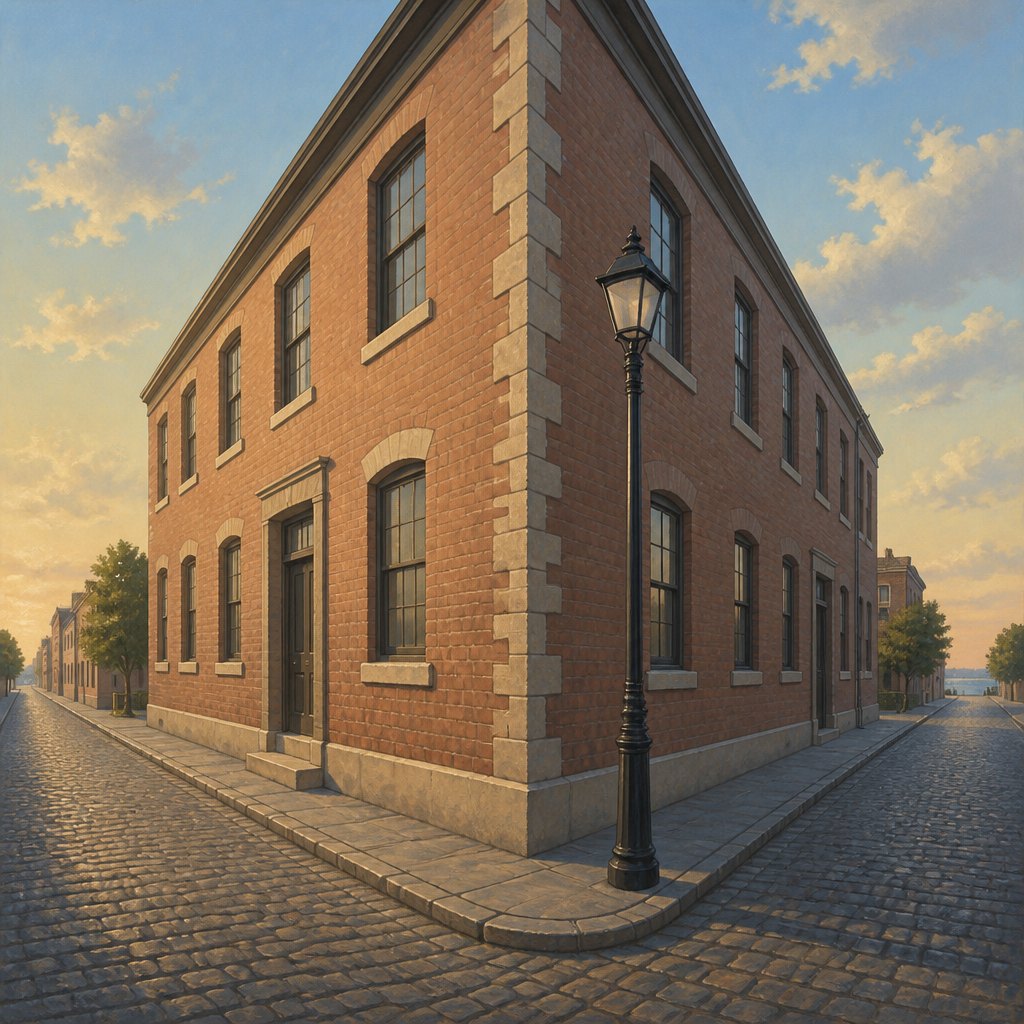
This example was generated from a prompt like: “A quiet brick building corner at street level, two facades receding sharply to separate vanishing points on a low horizon, cobblestone street, single lamppost with a perfectly vertical pole, soft late-afternoon light, clean architectural illustration style.”
Open the Two-Point Perspective Art Style generator →The concept today
Two-point perspective is now built into design software by default: SketchUp, Photoshop's vanishing-point filter, and game engines all offer two-point grids for laying out streets and buildings. Concept artists and comic illustrators still start city scenes by placing a horizon line and two vanishing points before drawing a single window. Architecture students learn it by hand before touching rendering software, since it's the fastest way to check whether a building reads correctly from a corner view. Tutorial channels teach it as the first 'real' perspective skill after one-point.
Compose your own
Start by drawing a horizon line across your page and marking two vanishing points, one near each edge, far enough apart that lines won't converge too sharply. Draw one vertical line for the nearest corner of your building or box, then connect its top and bottom to both vanishing points to establish the two receding faces. Add a second vertical for the far edge of each face, keeping every vertical parallel to the first — the moment verticals lean, you've drifted into three-point perspective. Practice on a real street corner or a cardboard box before attempting a full cityscape. Once the skeleton feels natural, try moving the horizon low to make buildings loom, or high to look down on a scene, the same trick de Chirico and Caillebotte both used for very different moods.
Frequently asked questions
What's the difference between one-point and two-point perspective?
One-point uses a single vanishing point for scenes viewed straight-on, like a hallway; two-point uses two vanishing points on the horizon for objects viewed at an angle, like a building corner, giving a more three-dimensional look.
Where do the vanishing points go in two-point perspective?
Both vanishing points sit on the horizon line, one to the left and one to the right of the subject, usually far enough outside the picture that the receding lines don't converge too abruptly.
Why do vertical lines stay straight in two-point perspective?
Because two-point perspective only accounts for horizontal recession; verticals remain parallel and upright. Once verticals also converge toward a point above or below, the system becomes three-point perspective.
What famous paintings use two-point perspective?
Gustave Caillebotte's Paris Street; Rainy Day (1877) shows a Parisian corner in two-point perspective, and Giorgio de Chirico's The Mystery and Melancholy of a Street (1914) uses an exaggerated two-point building to create unease.