 Art
Art
Linear perspective is a geometric system for drawing three-dimensional space onto a flat surface. Parallel lines that recede away from the viewer — the edges of a tiled floor, a row of columns, the sides of a road — are drawn converging toward a single point on the horizon called the vanishing point. Objects are also scaled smaller as they approach that point, matching how the eye actually perceives distance. Developed and codified in early Renaissance Florence, it gave painters a reliable mathematical method for constructing convincing architecture, interiors, and streets instead of guessing at depth by eye. A scene can use one vanishing point, for views facing straight down a hallway or street, two points, for objects seen at an angle like a building corner, or even three, for sharp views up or down. Linear perspective works hand in hand with diminishing scale and overlapping forms, and it remains the default way architects, illustrators, and game designers construct believable space today.
How artists use it
Orthogonal guidelines
Renaissance painters snapped floor tiles, ceiling beams, and tabletops to invisible lines called orthogonals, all radiating from one vanishing point. Drawing these guides first let artists place figures and furniture at a believably shrinking scale as they receded into space.
Vanishing point as focus
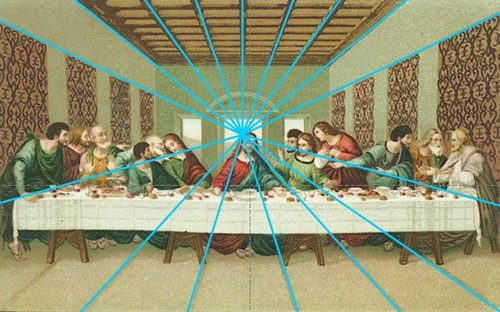
Placing the vanishing point directly behind a key figure's head, as Leonardo did in The Last Supper, uses the mechanics of perspective itself to pull a viewer's eye to the most important part of the composition, no matter how busy the rest of the scene is.
Two-point urban views
Painters showing a building or street corner at an angle, rather than head-on, use two vanishing points set on the horizon instead of one. Caillebotte's Parisian streets rely on this to capture the diagonal thrust of boulevards meeting at an intersection.
The horizon line
Every linear perspective construction depends on an implied horizon line at the viewer's eye level; all vanishing points sit on it. Raising or lowering that line changes whether the viewer feels like they are standing, kneeling, or looking down from above.
Checkerboard proof
Quattrocento painters loved tiled pavements because a receding grid makes converging orthogonals impossible to miss, turning the floor itself into visual proof of the room's depth — a favorite device in architectural interior scenes.
Perspective machines
Albrecht Dürer sketched artists peering through a gridded frame, or perspective machine, to trace a foreshortened model point by point onto a matching grid on paper — a mechanical shortcut for achieving mathematically accurate convergence without calculation.
Instant examples
Linear Perspective in famous works, fast
- Railroad tracks
- → the clearest real-world example — parallel rails visibly converge to a single point at the horizon.
- Checkerboard floor tiles
- → orthogonal grid lines in Renaissance interiors converge to prove the room's depth.
- Long corridor or hallway
- → walls, ceiling, and floor all narrow toward one point, exaggerating a sense of depth or unease.
- City street receding
- → building facades and curbs angle toward a vanishing point, as in Caillebotte's rainy Paris boulevards.
- Cathedral nave columns
- → repeated columns shrink in even steps, marching the eye toward the altar at the far end.
- Desk or table edges
- → converging edges of furniture in an interior scene quietly reinforce the room's perspective grid.
The story
Linear perspective was demonstrated, not just imagined, in Florence around 1415, when architect Filippo Brunelleschi used a mirror and a painted panel of the Baptistery to prove that a single vanishing point could accurately reproduce depth. Leon Battista Alberti codified the method in his 1435 treatise Della Pittura, giving painters step-by-step rules for constructing a perspective grid. Masaccio applied it almost immediately in his 1427 fresco Holy Trinity, and Piero della Francesca pushed its mathematics further in both his paintings and his treatise De Prospectiva Pingendi. The technique spread across Italy and north through Dürer's studies of perspective devices, becoming standard academic training for centuries. Photography later made perspective automatic, and twentieth-century Cubists deliberately fractured it, but architects, illustrators, and 3D software still build directly on Brunelleschi's fifteenth-century geometry.
The canonical examples
| Work | Artist | Date | Why it matters |
|---|---|---|---|
| Holy Trinity | Masaccio | 1427 | one of the earliest paintings with a mathematically consistent vanishing point, making the painted chapel appear to punch through the church wall |
| The Last Supper | Leonardo da Vinci | 1495–98 | orthogonal lines in the ceiling and walls converge precisely at Christ's head |
| The School of Athens | Raphael | 1509–11 | the coffered arches converge under the central vault framing Plato and Aristotle |
| The Ideal City | Unknown | c. 1480–1484 | the pavement's orthogonal lines converge with exacting precision to a single central point |
| Paris Street; Rainy Day | Gustave Caillebotte | 1877 | the diagonal street and building facades converge toward two separate vanishing points |
 AI-generated
Try it yourself
Practice linear perspective with AI
This example was generated from a prompt like: “A long stone corridor with a checkerboard tile floor, rows of arched columns on both sides shrinking evenly toward a single bright vanishing point at the far end, symmetrical, dramatic architectural depth.”
Open the Linear Perspective Art Style generator →The concept today
Architects and product designers still build renderings on one-, two-, and three-point perspective grids before anything is built. Video game engines calculate vanishing points in real time as a camera moves through a level. Comic artists and storyboard illustrators rely on perspective grids to keep invented spaces believable panel to panel. Photoshop includes a dedicated vanishing-point tool that pastes flat textures onto receding surfaces automatically, and perspective remains one of the first technical skills taught in any drawing curriculum.
Compose your own
Start by drawing a horizon line at your intended eye level, then mark one point on it — your vanishing point. Draw a simple box: send its top, bottom, and side edges back to that single point, and it will read as a receding room or crate. Practice with railroad tracks or a tiled floor, since a repeating grid makes any mistakes obvious. Once one-point perspective feels automatic, add a second vanishing point on the same horizon line to draw a building corner at an angle. Check your work by measuring how much a figure should shrink at each step back — perspective fails most often when scale and convergence stop agreeing.
Frequently asked questions
What is linear perspective in art?
Linear perspective is a drawing system where parallel lines receding into the distance are drawn converging toward a vanishing point on the horizon, and objects shrink in scale as they get farther away, creating a convincing illusion of depth on a flat surface.
Who invented linear perspective?
The Florentine architect Filippo Brunelleschi demonstrated it around 1415 using a mirror and a painted panel, and Leon Battista Alberti codified the mathematical rules in his 1435 treatise Della Pittura, making it teachable to other painters.
What is the difference between one-point and two-point perspective?
One-point perspective uses a single vanishing point for scenes viewed straight-on, like a hallway; two-point perspective uses two vanishing points on the horizon for objects seen at an angle, like a building corner.
How do you find the vanishing point in a painting?
Trace any two parallel lines that appear to recede into the distance, such as a floor's edges or a row of columns, and extend them until they meet; that intersection on the horizon line is the vanishing point.