 Art
Art
Form in art is the quality of having, or appearing to have, three dimensions: height, width, and depth. In sculpture and architecture, form is real; you can walk around a statue or a building and see new sides appear. In painting and drawing, form is an illusion, built through shading, called modeling, that fakes the way light would actually fall across a rounded object. A flat circle becomes a solid sphere the moment an artist adds a gradient from light to shadow, plus a small highlight and a soft reflected light on the shadow side. Form is closely tied to value, since shading is the main tool used to suggest it, but the two are not identical: value is about lightness and darkness in general, while form is specifically about using that light and dark to describe volume. Geometric forms, cubes, spheres, cylinders, and cones, are the basic building blocks art students learn to render before attempting anything more complex, because almost every solid object in the world can be broken down into some combination of those four.
How artists use it
Modeling with light
Michelangelo's marble David has real, sculpted form, but his Sistine Chapel ceiling figures achieve the same solidity through paint alone, using dramatic shading to make flat plaster read as muscled, rounded bodies. The painted figures prove illusionary form can rival the real thing.
Chiaroscuro volume
Caravaggio pushed form to its most dramatic extreme in works like The Calling of Saint Matthew, using violent contrasts between deep shadow and a single shaft of light to carve figures out of near-total darkness. The technique, chiaroscuro, remains the go-to method for faking volume with paint.
Faceted form
Paul Cézanne treated mountains and fruit alike as arrangements of underlying geometric solids in works like Mont Sainte-Victoire, famously advising artists to treat nature by the cylinder, the sphere, and the cone. His approach directly inspired the faceted, geometric form of Cubism that followed.
Sculptural form in the round
Auguste Rodin's The Thinker exists as pure, real form, meant to be viewed from every angle, with muscles and posture that only fully make sense once you walk around the bronze. Sculpture is the one medium where form needs no illusion at all.
Biomorphic abstraction
Henry Moore reduced the human figure to smooth, hollowed, abstract volumes in his reclining figure sculptures, treating form as something to be simplified and opened up rather than rendered in exact anatomical detail. His holes and curves show form can be suggested, not just described.
Architectural mass
Frank Lloyd Wright's Fallingwater treats form at building scale, stacking concrete slabs as cantilevered horizontal masses that seem to float over a waterfall. It shows form operating as pure structural weight and balance, the same principle a sculptor manages at a tabletop scale.
Instant examples
Form in famous works, fast
- David
- → form in the round — real sculpted volume shows anatomical form from every viewing angle.
- The Calling of Saint Matthew
- → chiaroscuro — a single light source carves figures out of deep shadow to fake three-dimensional volume.
- Mont Sainte-Victoire
- → faceted form — the mountain and landscape are simplified into underlying geometric solids.
- The Thinker
- → mass and weight — bronze form reads as heavy, grounded, and physically present.
- Fallingwater
- → architectural form — cantilevered concrete slabs turn a building into stacked horizontal mass.
- Reclining Figure
- → abstracted volume — smooth, hollowed shapes simplify the body into pure rounded form.
The story
Form as illusion became a central Renaissance obsession once artists mastered chiaroscuro and single-point perspective, techniques that let flat panels convincingly fake volume for the first time. Leonardo da Vinci refined sfumato, a smoky blending of tones, to model form with no visible edges at all. Caravaggio later pushed illusionary form to theatrical extremes with harsh directional light. In sculpture, form has always been literal rather than illusionary, from classical Greek marble through Renaissance bronze to Rodin's expressive, unfinished surfaces. Cézanne's late work bridged the two traditions, arguing that painted form should acknowledge its underlying geometric structure rather than hide it, an idea Cubists took even further by fracturing form into overlapping planes. Twentieth-century sculptors like Moore and Brâncuși then simplified real form down to its essential volumes, stripping away surface detail entirely.
The canonical examples
| Work | Artist | Date | Why it matters |
|---|---|---|---|
| David | Michelangelo | 1501–04 | real sculpted form, meant to be studied from every angle |
| The Calling of Saint Matthew | Caravaggio | 1599–1600 | chiaroscuro shading carves dramatic volume out of darkness |
| Mont Sainte-Victoire (series) | Paul Cézanne | 1882–1906 | landscape simplified into underlying cylinders, spheres, and cones |
| The Thinker | Auguste Rodin | 1904 | bronze mass and weight define the figure's real, physical form |
| Fallingwater | Frank Lloyd Wright | 1939 | cantilevered concrete slabs turn architecture into stacked horizontal form |
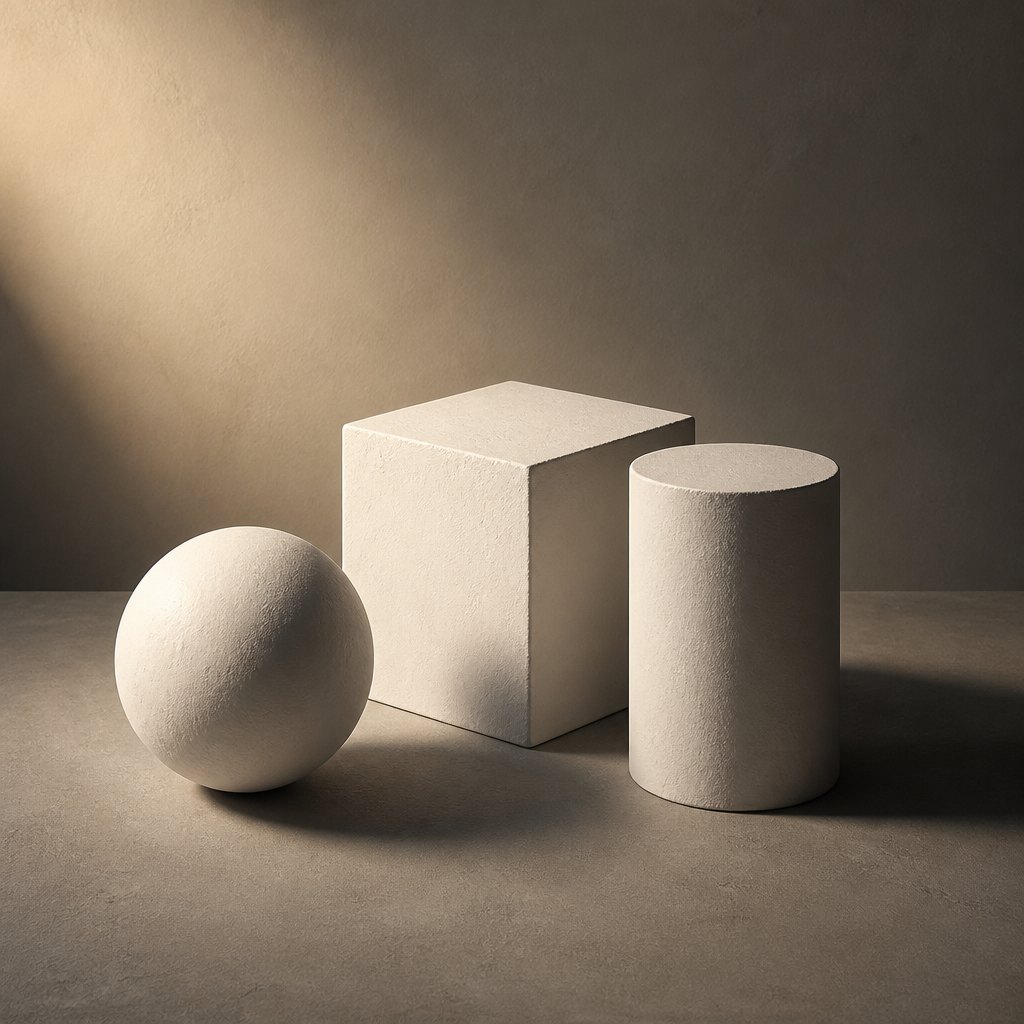 AI-generated
Try it yourself
Practice form with AI
This example was generated from a prompt like: “A plain white plaster sphere, cube, and cylinder arranged together on a gray tabletop, lit from one side by a single warm lamp, casting long soft shadows and clear highlights across each form, minimalist still life, studio setting.”
Open the Sculptural Form Art Style generator →The concept today
Form is the whole basis of 3D modeling software, video game asset design, and product prototyping, where objects are literally built from digital spheres, cubes, and cylinders before texture is applied. Photographers control form with lighting setups, positioning a single strong light source to carve out volume on a face or product the way a painter once did with a brush. AI image generators are frequently pushed to render strong form or volumetric lighting as an explicit prompt term, since flat lighting is the most common failure mode in generated images.
Compose your own
To make a flat shape read as solid form, add a full value range across it: a highlight where light hits directly, a mid-tone across the bulk of the surface, a core shadow where the surface turns away from the light, and a touch of reflected light bouncing back into that shadow from the surroundings. Keep your light source consistent across an entire image; volume falls apart the moment shadows point in different directions on different objects. Start any complex object by blocking it in as a simple geometric solid, a sphere, cube, cylinder, or cone, before adding surface detail, since almost everything solid can be reduced to some combination of those four shapes. In three-dimensional work, walk around your piece as you build it; form that only looks right from one angle is not yet finished.
Frequently asked questions
What are examples of form in art?
Michelangelo's David shows real sculpted form in marble, Caravaggio's The Calling of Saint Matthew fakes volume with chiaroscuro shading, Cézanne's Mont Sainte-Victoire paintings simplify landscape into geometric solids, and Rodin's The Thinker uses bronze mass to convey physical weight.
What is the difference between form and shape?
Shape is flat, describing only length and width. Form adds depth, either real, as in sculpture and architecture, or illusionary, achieved on a flat surface through shading that mimics how light falls across a rounded, three-dimensional object.
What are the four basic geometric forms in art?
The sphere, cube, cylinder, and cone are the four basic geometric solids art students learn to shade first, because nearly every complex object in the world, from a head to a teapot, can be broken down into some combination of them.
How do artists create the illusion of form on a flat surface?
By modeling: adding a highlight, mid-tone, core shadow, and reflected light across an object in a consistent direction, matching how a real light source would actually fall across a rounded surface. Consistent shadow direction is what sells the illusion.