 Art
Art
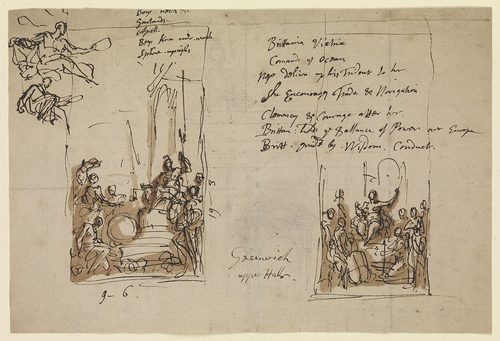

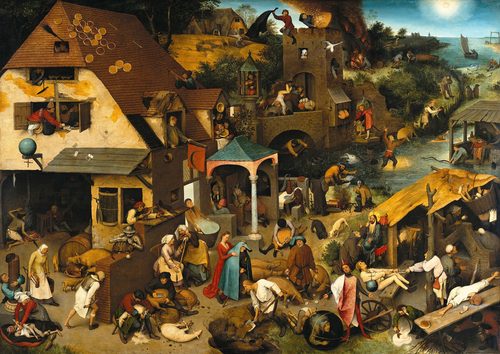
Framing is a compositional device in which objects inside the picture — an archway, a doorway, a window, overhanging tree branches, even another figure's shoulder — surround the main subject and enclose it within a secondary border. Unlike the physical frame around a finished artwork, this frame exists inside the image itself, doing compositional work rather than decorative work. Framing draws the eye inward toward the subject, blocks out distracting peripheral space, and adds depth by separating a darker, closer foreground element from a brighter, farther subject. It can carry narrative meaning too: a window suggests a view glimpsed from inside, a doorway suggests catching a private moment, and a mirror suggests a scene nested within the main one. Landscape painters long used framing trees, called coulisses, to push the eye toward a distant vista, while photographers still hunt for natural frames, branches, tunnels, fences, to give an ordinary scene structure and depth.
How artists use it
Coulisses in landscape
Painters framed sweeping views with dark trees or rock at the canvas edges, a device called coulisses, borrowed from theater wings. Placing these shapes in shadow pushes the sunlit vista behind them further into the distance.
Doorways and doorkijkjes
Dutch genre painters loved the doorkijkje, or 'through-view,' opening a doorway in the middle ground to reveal another room or courtyard beyond. The doorway itself becomes a frame nested inside the picture's outer edges.
Windows as frames
A window turns a glimpse of the outside world into a composed picture of its own, cutting off distracting surroundings and suggesting the viewpoint of someone standing inside looking out.
Mirrors as frames
A convex or flat mirror painted into a scene creates a small framed picture within the picture, often showing details, extra figures or a different angle of the room, invisible anywhere else in the composition.
Architectural arches
An archway or window opening in the foreground darkens the edges of a composition and funnels attention toward a brightly lit subject or landscape framed neatly at its center.
Photographic natural frames
Photographers look for existing frames in a scene, branches, tunnel mouths, fences, and position the camera so the frame's edges align with the picture's own borders, adding depth without any editing.
Instant examples
Framing in famous works, fast
- Church archway in Renaissance paintings
- → a foreground arch frames a distant landscape or figure, common in Italian Renaissance devotional and architectural paintings.
- Coulisse trees at the edge of a landscape
- → dark foreground trees frame a sunlit valley or vista, a classical landscape-painting convention.
- Open window in a genre painting
- → a window frames a view outside or a beam of light, common in Dutch interior scenes.
- Doorway in a Dutch interior
- → an open door frames a glimpse of another room or a courtyard beyond, known as a doorkijkje.
- Convex mirror on a back wall
- → a small framed reflection nested within the larger composition, revealing details unseen elsewhere.
- Tree branches overhanging a photograph
- → foliage frames the edges of a photo, a favorite trick for adding foreground depth to landscape shots.
The story
Framing devices appear as far back as Netherlandish panel painting, where painted architectural borders and niches enclosed sacred figures. Dutch genre painters of the 1600s developed the doorkijkje, an open doorway revealing another room, turning ordinary domestic architecture into a frame within a frame. Landscape painters of the same century, especially in France and Italy, used coulisses, dark framing trees or rocks copied from stage-set wings, to push a bright, distant view deeper into space; the convention was so associated with idealized landscapes that 18th-century English tourists carried a tinted 'Claude glass' to view real scenery pre-framed the way a painting would be. American Hudson River School painters of the 1830s and 1840s inherited this device, framing wilderness panoramas with foreground trees and rock outcrops. Early photographers, working with cameras that already imposed a rectangular frame, adopted the same trick almost immediately, searching for arches, windows, and branches to frame their shots naturally.
The canonical examples
| Work | Artist | Date | Why it matters |
|---|---|---|---|
| View from Mount Holyoke, Northampton, Massachusetts, after a Thunderstorm (The Oxbow) | Thomas Cole | 1836 | a wind-blasted foreground tree arches over the left edge, framing the panoramic valley beyond |
| Plum Park in Kameido | Utagawa Hiroshige | 1857 | a close plum tree trunk and blossoming branches cut across the foreground, framing the garden view behind them |
| The Courtyard of a House in Delft | Pieter de Hooch | 1658 | an open doorway, a doorkijkje, frames a glimpse of a woman standing in the passage beyond the courtyard |
| The Arnolfini Portrait | Jan van Eyck | 1434 | a convex mirror on the back wall frames a tiny reflected view of the room and two additional figures |
| Las Meninas | Diego Velázquez | 1656 | a brightly lit doorway at the rear of the room frames the silhouette of a man pausing on the stairs |
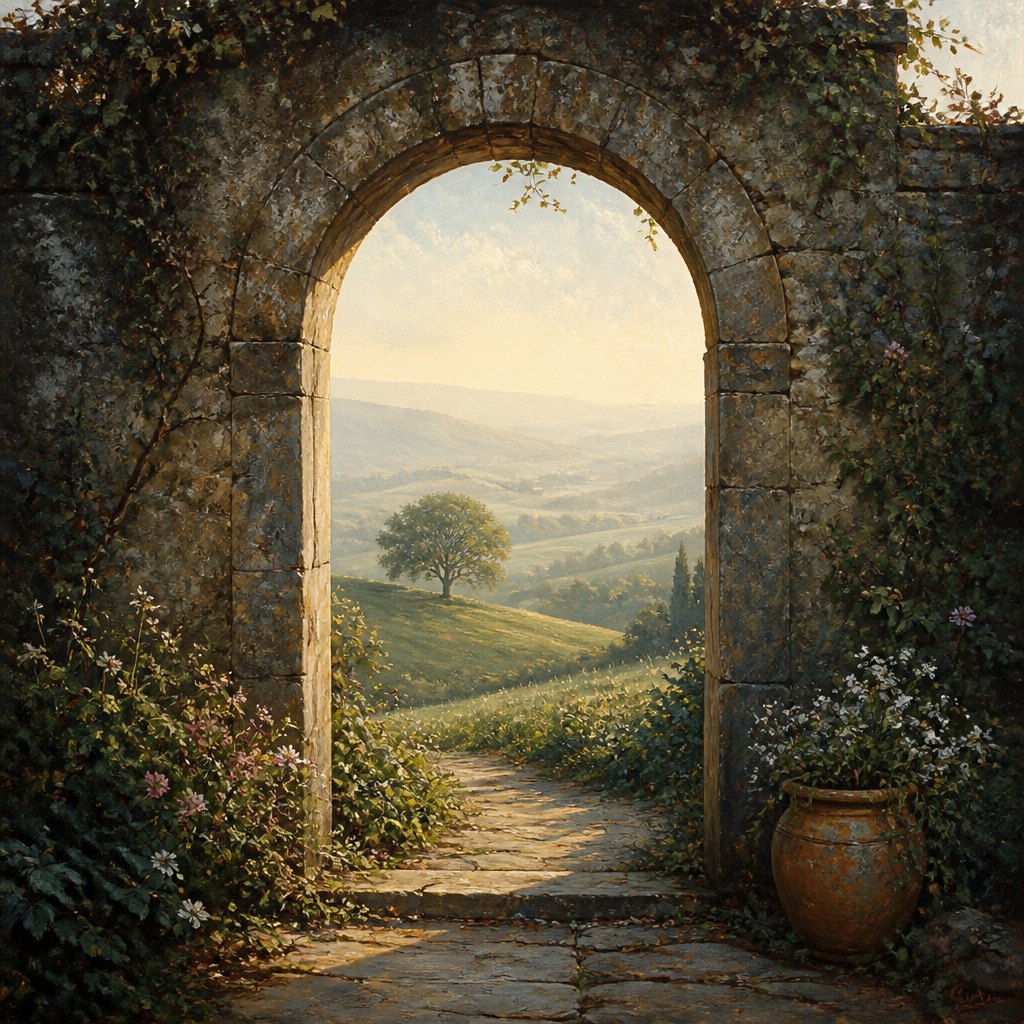 AI-generated
Try it yourself
Practice framing with AI
This example was generated from a prompt like: “A weathered stone archway in an old garden wall framing a distant view of rolling hills and a single tree, soft morning light, foreground archway in shadow, deep central vista, painterly landscape style.”
Open the Framing Art Style generator →The concept today
Framing remains a default composition rule in photography, taught alongside the rule of thirds: shoot a subject through a doorway, under a bridge, or between tree branches to add instant depth. Filmmakers frame characters in windows, mirrors, and door frames to suggest isolation or surveillance. Architects design windows deliberately as 'living frames' for a landscape or skyline. Smartphone camera apps even overlay grid guides that make it easy to spot natural frames, arches, tunnels, foliage, while composing a shot in real time.
Compose your own
Walk around a subject looking for existing frames before you shoot anything: a doorway, a gap between branches, a car window, an archway. Position your camera or easel so the frame's edges roughly align with the picture's outer borders, letting foreground material go slightly dark or soft-focused so it doesn't compete with the subject. In landscape drawing, add a framing tree or rock formation at one or both edges and shade it darker than the rest of the scene to push the main view backward in space. Try a mirror or reflective surface as an inner frame, placing a secondary detail inside it that isn't visible anywhere else in the composition. Compare a shot with a natural frame to the same shot without one, and note how much deeper the framed version feels.
Frequently asked questions
What is framing in art?
Framing is a composition technique where elements inside the scene itself, an archway, doorway, window, or tree branches, enclose the main subject, adding depth and directing the viewer's eye toward it.
What is a frame within a frame in photography?
It means using a natural or architectural opening, like a doorway, tunnel, or window, positioned so its edges echo the photograph's own rectangular border, creating a picture nested inside the picture.
What is the difference between framing and cropping?
Framing adds enclosing elements inside the scene to surround a subject, while cropping removes part of the scene by cutting it off at the picture's own edge; framing adds depth, cropping creates immediacy.
Why do landscape painters use trees to frame a view?
Dark foreground trees, called coulisses, block distracting space at the edges and push the eye toward a brighter, more distant vista, making the landscape feel deeper and more three-dimensional.