 Art
Art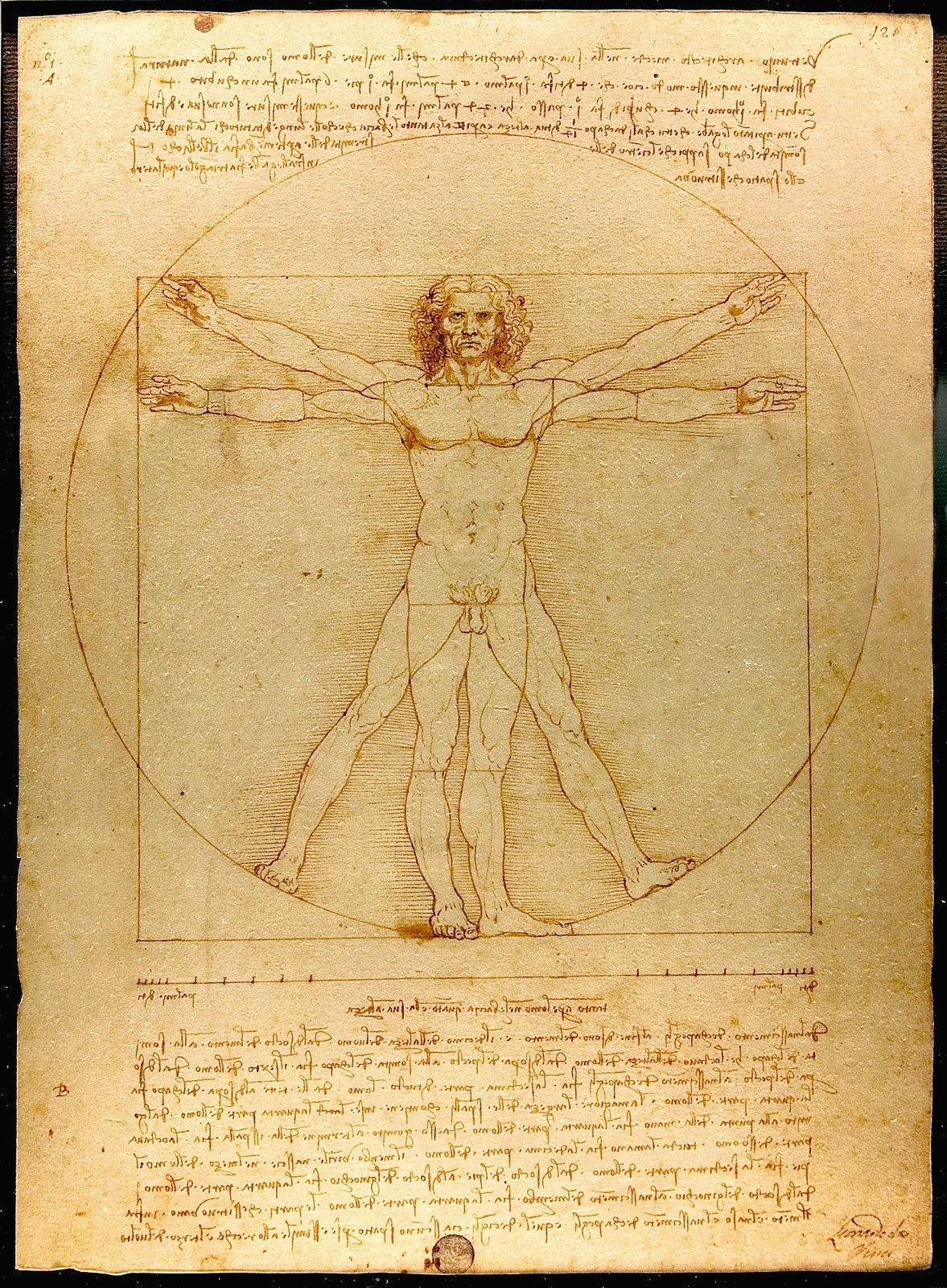
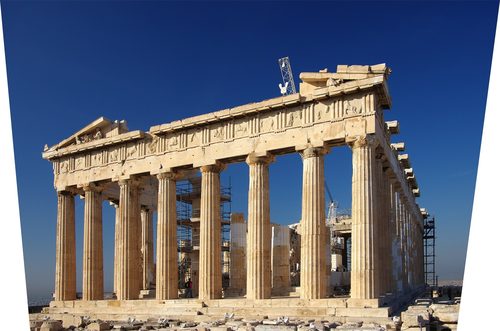
The golden ratio is the number phi, approximately 1.618, that emerges when a line is divided so the whole relates to the longer segment the same way the longer segment relates to the shorter one. A rectangle built on that ratio can have a square removed from one end and leave a smaller rectangle of identical proportions, over and over, tracing a spiral as it shrinks. Because a similar spiral appears in nautilus shells and sunflower seed heads, the ratio earned nicknames like the divine proportion and became a design shorthand for a naturally pleasing canvas, facade, or crop. Artists since the Renaissance have built compositions around golden rectangles and spirals on purpose. Many popular claims about the ratio hiding inside specific historic works, from the Parthenon to the Mona Lisa, remain debated approximations rather than confirmed intent — but used deliberately, it's a real formula for balancing a composition's largest and smallest masses.
How artists use it
Golden rectangle canvas
Some painters and printmakers choose panel or canvas dimensions close to the golden ratio's 1.618-to-1 proportion before a single mark is made, so the picture's outer frame itself already carries the balance the composition inside will echo.
Spiral compositional path
Artists sometimes plot a logarithmic spiral through nested golden rectangles and arrange a composition's largest shapes, a figure's head, a boat, a tree, along that curling path, guiding the eye inward toward a focal point at the spiral's tightest turn.
Renaissance proportion theory
Luca Pacioli's 1509 treatise De Divina Proportione, illustrated by Leonardo da Vinci with drawings of geometric solids, argued that the golden ratio underlies both beautiful architecture and well-proportioned painting, tying mathematics directly to aesthetics.
Classical architectural proportion
Ancient and Renaissance architects divided facades, columns, and doorways using ratios historians have repeatedly compared to phi, though whether Greek builders calculated the ratio consciously or arrived at it through practical harmony remains debated.
Study from nature
Botanical and shell studies showing spiral seed heads or chambered shells were used by artists and naturalists as visual proof that the same proportion recurring throughout the natural world could be borrowed deliberately for artificial compositions.
Modern cropping guides
Photo-editing software and design templates now offer a golden-spiral overlay alongside the standard rule-of-thirds grid, letting a designer or photographer test both proportions on the same image before deciding how to crop it.
Instant examples
Golden Ratio in famous works, fast
- A nautilus shell cross-section
- → its spiral chambers grow in a ratio close to phi, making it art history's favorite natural stand-in for the golden ratio.
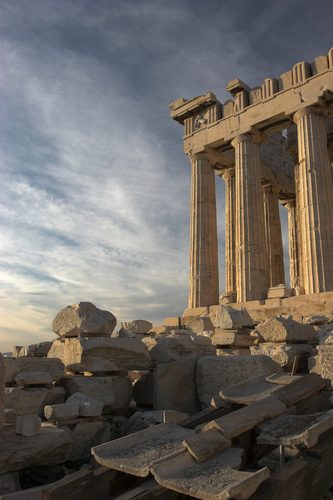
- The Parthenon's facade
- → its width-to-height proportions are often compared to the golden ratio, though no surviving Greek text confirms deliberate use.
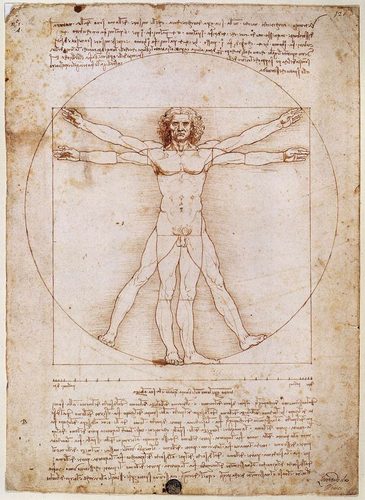
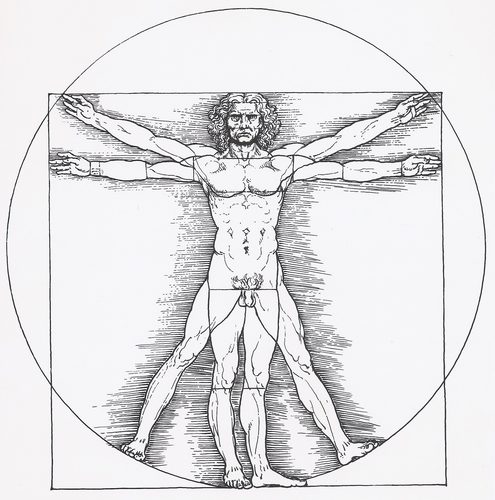
- Vitruvian Man
- → Leonardo's figure inscribed in a circle and square, frequently linked to golden-ratio proportion discussions of the ideal body.
- Mona Lisa framing diagrams
- → popular overlays sketch golden rectangles onto the portrait's framing, though Leonardo left no note confirming the intent.
- The golden spiral diagram
- → a curling line drawn through shrinking nested rectangles, used in classrooms to visualize the ratio's self-similar structure.
- A sunflower seed head
- → its spiraling seed pattern is a standard textbook example of the ratio's approximate appearance in living things.
The story
The ratio itself goes back to Euclid's Elements, around 300 BCE, which defined dividing a line in "extreme and mean ratio." The term "golden section" is much younger, first used in German by mathematician Martin Ohm in 1835. In between, Renaissance friar Luca Pacioli published De Divina Proportione in 1509, illustrated with polyhedra drawn by Leonardo da Vinci, arguing the ratio held both mathematical and near-mystical aesthetic significance. In the nineteenth century, thinkers like Adolf Zeising applied the ratio broadly across art, architecture, and biology, often overreaching in the process, and many of the specific claims attached to ancient and Renaissance masterpieces date from this later enthusiasm rather than the artists' own testimony. Contemporary art historians treat most of those specific attributions skeptically, even as designers keep teaching the spiral as a genuinely useful compositional guide.
The canonical examples
| Work | Artist | Date | Why it matters |
|---|---|---|---|
| Vitruvian Man | Leonardo da Vinci | c. 1490 | a pen-and-ink drawing inscribing the human body in a circle and square to study ideal proportion, often linked to golden-ratio discussion |
| The Parthenon | Iktinos and Kallikrates | 447–432 BCE | the temple's facade proportions are frequently cited as approximating the golden ratio, though ancient deliberate use is unconfirmed |
| De Divina Proportione (illustrations) | Leonardo da Vinci | 1509 | drawings of Platonic solids illustrating Luca Pacioli's treatise on the golden ratio's mathematical and aesthetic properties |
| Mona Lisa | Leonardo da Vinci | c. 1503–1519 | popular diagrams overlay golden rectangles onto the portrait's framing, though no historical record confirms deliberate use |
| Chambered nautilus shell | Unknown | natural form | its chambers expand in a logarithmic spiral often compared to, though not mathematically identical to, the golden spiral |
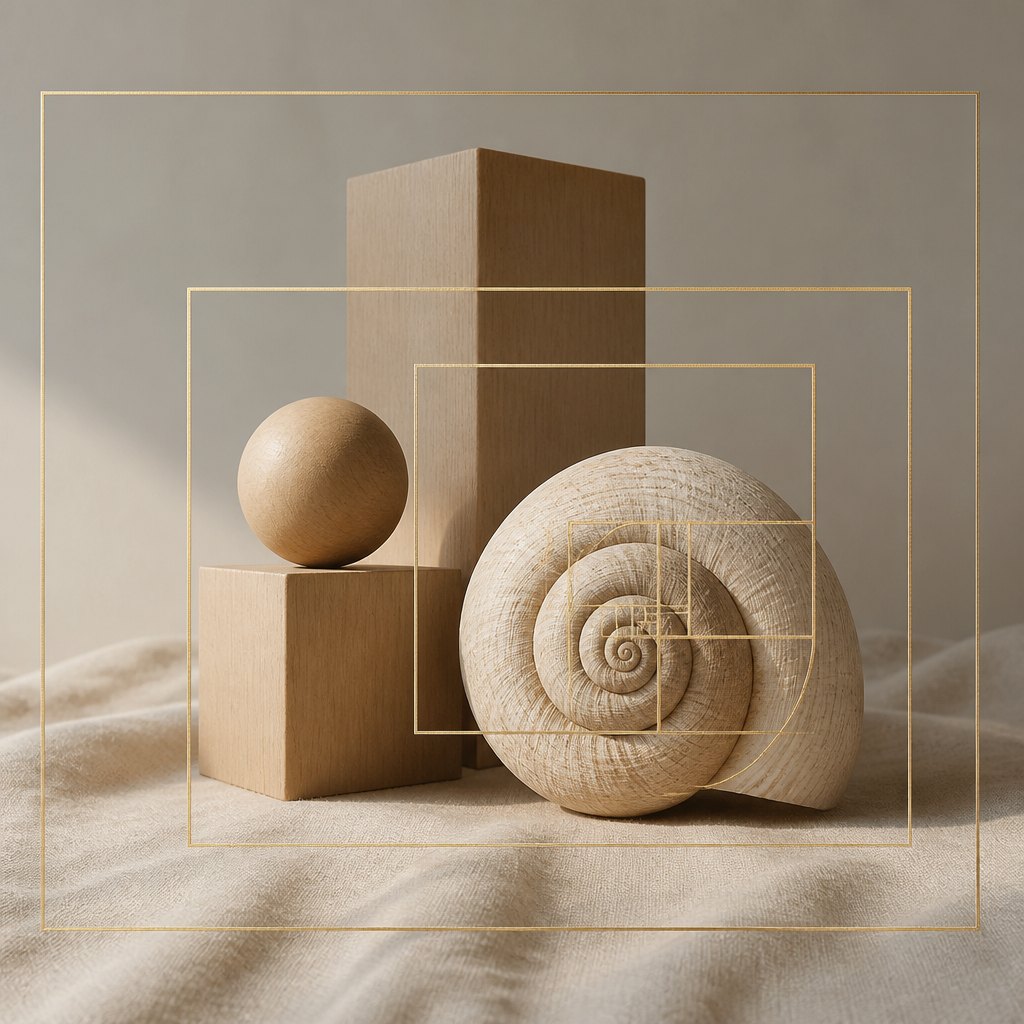 AI-generated
Try it yourself
Practice golden ratio with AI
This example was generated from a prompt like: “A nested sequence of shrinking golden rectangles drawn in thin gold line over a plain still life of a spiral seashell and smooth geometric wooden blocks, arranged on a pale linen surface, soft studio light.”
Open the Golden Ratio Art Style generator →The concept today
Graphic designers still overlay golden spirals on logos and layouts, and photo apps offer the spiral as a cropping guide alongside the rule of thirds. Architecture and product-design courses teach the ratio as a proportion template for facades, packaging, and typography grids. At the same time, mathematicians and art historians regularly publish debunkings of overstated golden-ratio claims attached to famous artworks, keeping the idea simultaneously popular and contested in equal measure.
Compose your own
Construct a golden rectangle with a compass and straightedge starting from a square, then keep removing squares from the remainder to trace your own spiral by hand. Overlay that spiral on a photograph or sketch and see whether your existing focal point already sits near the spiral's tight curl. Try composing a still life twice, once fitted to a golden rectangle canvas and once to a plain square, and compare which balance feels more dynamic. Finally, test a famous overlay diagram yourself against a printed reproduction to see how convincingly, or not, it actually fits.
Frequently asked questions
What is the golden ratio in art?
It's a proportion, roughly 1.618 to 1, that some artists use deliberately to size canvases, rectangles, and spirals within a composition, based on a mathematical relationship first defined in Euclid's Elements around 300 BCE.
Did Leonardo da Vinci really use the golden ratio in the Mona Lisa?
It's debated. Popular diagrams overlay golden rectangles onto the painting, but no writing from Leonardo confirms he planned the composition around phi specifically, so historians treat the claim as an appealing but unproven pattern.
Is the golden ratio the same as the rule of thirds?
They're related but not identical. The rule of thirds is a simplified, easy-to-eyeball approximation of the same kind of balance the golden ratio describes exactly through the irrational number 1.618.
Where is the golden ratio found in nature?
It appears approximately in the spiral growth patterns of nautilus shells, the seed arrangement of sunflowers, and pinecone scales, all of which grow according to related mathematical spiral patterns.