 Art
Art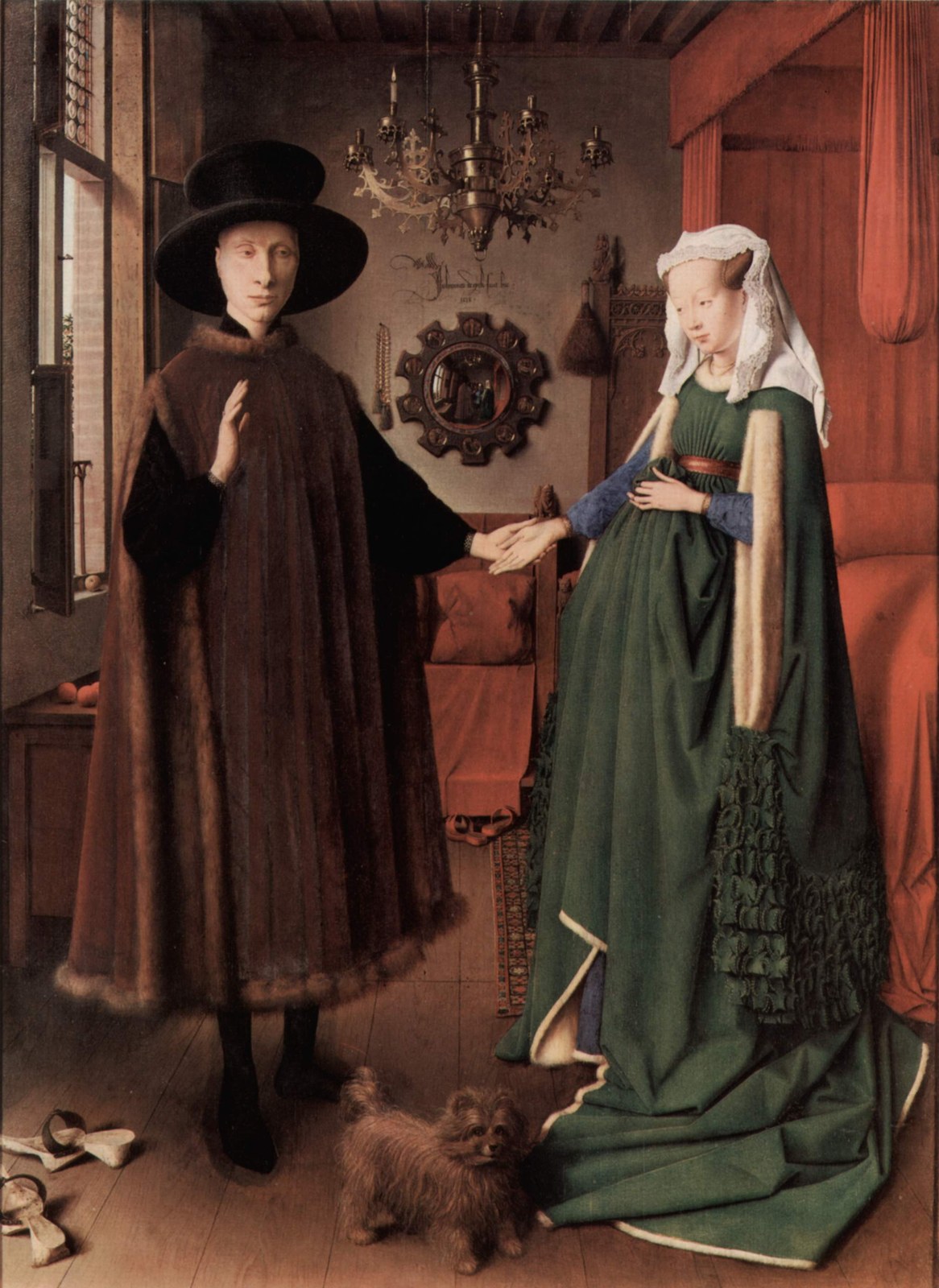
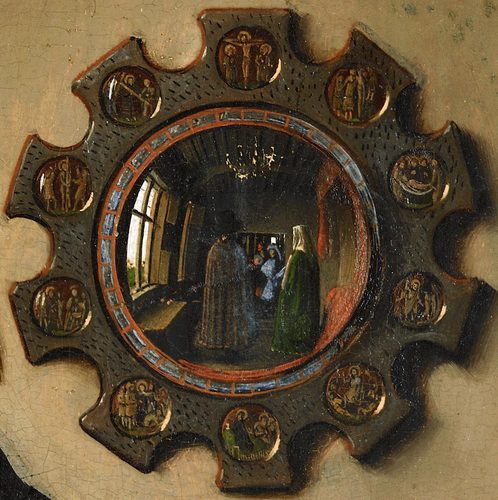
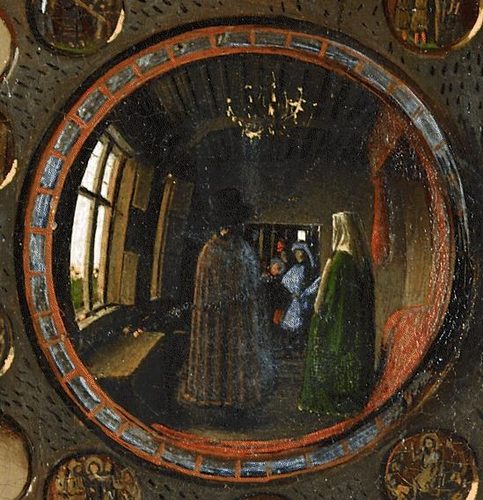
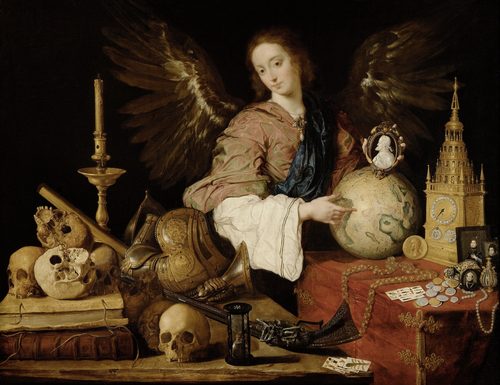
Symbolism in art is the practice of loading ordinary objects, colors, animals, or gestures with meaning beyond their literal appearance, turning a still life or portrait into a coded message a trained viewer can decode. A skull does not just depict a skull; it announces mortality. A dog at a couple's feet is not merely a pet but a pledge of fidelity. A single candle, a mirror, a wilting flower, or a particular shade of blue can each carry centuries of accumulated meaning drawn from religion, mythology, folklore, or social custom. Symbolism can be explicit, like the attributes that identify a saint, or disguised, woven so naturally into a scene's furniture that it looks like ordinary decor until you know what to look for — a technique art historians call disguised symbolism. It rewards close looking: the same painting can read as a domestic scene or a dense meditation on death, faith, and time, depending on whether the viewer recognizes its vocabulary of objects.
How artists use it
Disguised symbolism
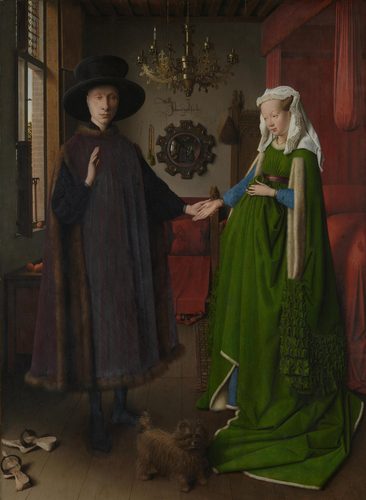
In the Arnolfini Portrait, Jan van Eyck hides devotional meaning in ordinary furnishings: a single candle, a small dog, and oranges on a chest. The objects look like decor but each carries a marital or religious meaning.
Memento mori objects
Dutch and Flemish still-life painters filled vanitas scenes with skulls, hourglasses, and guttering candles to remind viewers life is short. Philippe de Champaigne reduced the message to three objects: a tulip, a skull, and an hourglass in a row.
Floriography
Victorian painters relied on the language of flowers to add unspoken commentary. In Millais's Ophelia, poppies suggest death, daisies suggest innocence, and pansies allude to love thought in vain, turning the riverbank into a coded elegy.
Anamorphic symbols
Hans Holbein the Younger hid a skull in plain sight in The Ambassadors, stretching it into an unreadable smear unless viewed from a sharp angle. The distorted symbol reminds the sitters, surrounded by wealth, that death watches from an odd angle.
Color symbolism
Painters assigned fixed meanings to pigments long before abstraction: ultramarine blue marked purity and heaven in devotional paintings, while red signaled passion, sacrifice, or danger. Choosing a color was rarely a neutral decision.
Attributes and identity
Medieval and Renaissance viewers identified figures by their attributes rather than faces: keys mean Saint Peter, a wheel means Saint Catherine, a lion means Saint Jerome. The convention let painters pack identity into one recognizable object.
Instant examples
Symbolism in famous works, fast
- Skull in a still life
- → vanitas — a reminder that death comes for everyone, no matter how richly the rest of the painting is furnished.
- Hourglass or clock
- → the passage of time — a quiet warning that life, and the moment being painted, is already running out.
- Small dog at a sitter's feet
- → fidelity — a common shorthand for loyalty in marriage and portrait painting, as in the Arnolfini Portrait.
- Convex mirror
- → truth or vanity — it can reveal what's outside the frame or remind a sitter of self-regard, depending on context.
- Snuffed or guttering candle
- → a life recently extinguished, or the fragile brevity of a single human lifespan.
- Wilting or floating flowers
- → mortality and lost innocence, as in the specific blooms scattered around Millais's drowning Ophelia.
The story
Symbolic objects appear as far back as ancient Egyptian tomb painting, where specific animals and colors carried fixed religious meaning. Medieval Christian art formalized a whole vocabulary of attributes so illiterate worshippers could identify saints by their possessions rather than their faces. Northern Renaissance painters like Jan van Eyck perfected disguised symbolism in the 1430s, folding religious and marital meaning into the ordinary furniture of a domestic room. Dutch Golden Age still-life painters of the seventeenth century built an entire genre, vanitas, around skulls, hourglasses, and wilting flowers meant to check earthly pride. The Pre-Raphaelite Brotherhood revived dense natural symbolism in the 1850s, cataloguing real flowers with real folkloric meanings in paintings like Millais's Ophelia. By the late nineteenth century, the Symbolist movement of Odilon Redon and Gustave Moreau pushed further, using imagery to evoke inner psychological states rather than fixed, decodable meanings.
The canonical examples
| Work | Artist | Date | Why it matters |
|---|---|---|---|
| Arnolfini Portrait | Jan van Eyck | 1434 | a single candle, a small dog, and discarded shoes fold marital and religious symbolism into an ordinary bedroom scene |
| Vanitas Still Life | Philippe de Champaigne | c. 1671 | a tulip, skull, and hourglass are lined up to spell out life, death, and time in three objects |
| Ophelia | John Everett Millais | 1851–52 | the flowers floating around her — poppies, daisies, pansies — each carry a specific Victorian meaning of death, innocence, or lost love |
| The Ambassadors | Hans Holbein the Younger | 1533 | an anamorphic skull stretched across the foreground only resolves into a clear image when viewed from a sharp side angle |
| Still Life with a Skull | Pieter Claesz | 1628 | a skull paired with an overturned glass and snuffed candle turns a simple tabletop into a meditation on mortality |
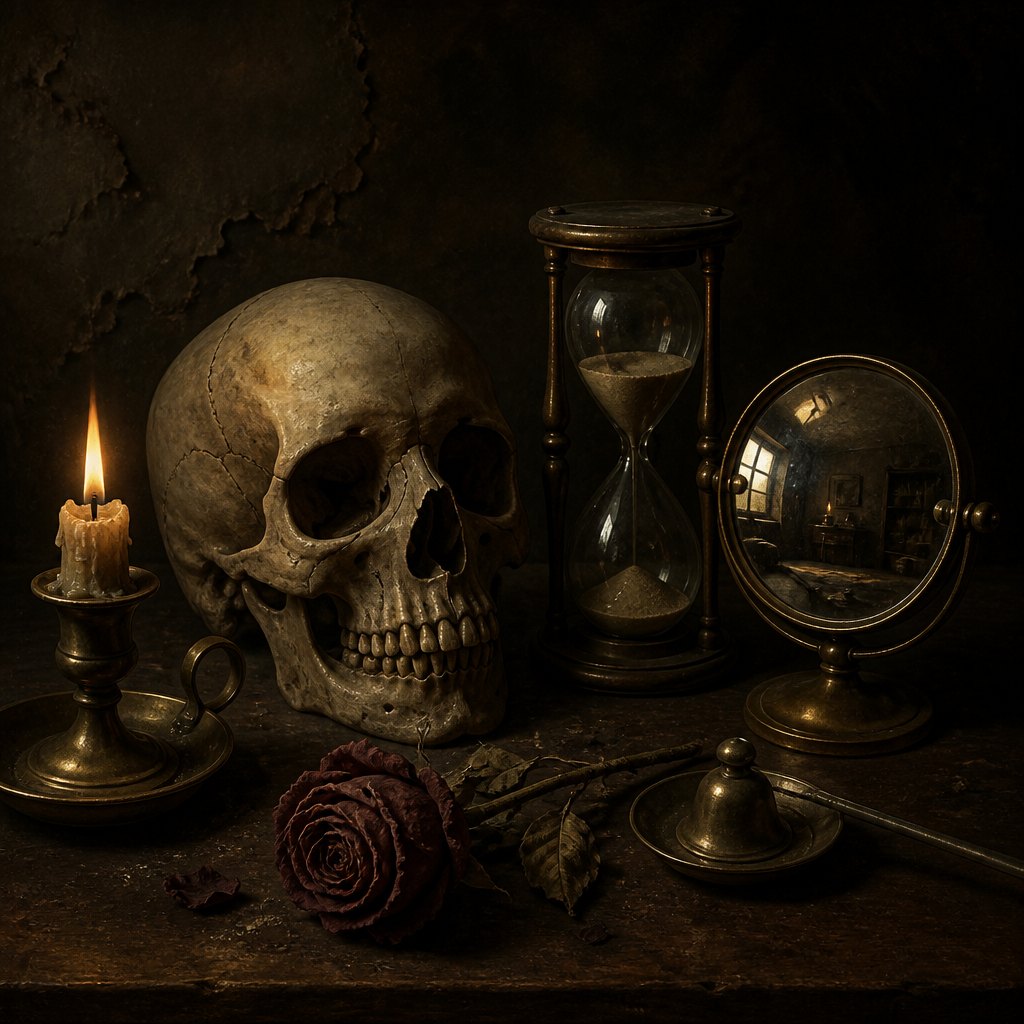 AI-generated
Try it yourself
Practice symbolism with AI
This example was generated from a prompt like: “A candlelit still-life arrangement of a human skull, an hourglass, a snuffed candle, a wilting rose, and a small convex mirror reflecting the room, dark wood table, moody chiaroscuro lighting, symbolic vanitas composition.”
Open the Symbolism Art Style generator →The concept today
Symbolic shorthand never left visual culture; it just moved into new formats. Logos load a single icon, an apple, a swoosh, with instant brand meaning. Emoji function as pure symbolism, tiny pictures standing in for entire emotions. Album covers, tarot decks, and horror-film props still lean on skulls, mirrors, and candles exactly as vanitas painters did. Memes work by the same symbolic substitution, letting one image stand for a recognizable feeling.
Compose your own
Pick one abstract idea, mortality, loyalty, vanity, and choose a concrete object that has already accumulated cultural meaning rather than inventing a private code no viewer can read. Place that object in an otherwise ordinary setting so it reads as both real and symbolic, the way van Eyck hid meaning in a chandelier. Research a symbol's history before using it, since flowers, animals, and colors carry different meanings across cultures. Try painting the same still life twice, once purely descriptive and once with one symbolic substitution, to feel how much a single loaded object changes a scene's meaning.
Frequently asked questions
What is symbolism in art?
Symbolism is the use of objects, colors, or figures to represent ideas beyond their literal appearance — a skull for mortality, a dog for fidelity, a flower for lost love — turning an ordinary scene into a coded message.
What do the objects in the Arnolfini Portrait symbolize?
Jan van Eyck's 1434 painting hides marital and religious meaning in everyday items: a single candle suggests a sacred presence, a small dog signals fidelity, and discarded shoes mark the room as holy ground.
What is a vanitas still life?
A vanitas is a still-life genre, especially popular in the seventeenth-century Netherlands, that arranges skulls, hourglasses, and snuffed candles to remind viewers that earthly wealth and life itself are temporary.
What is the difference between symbolism and allegory?
Symbolism uses individual objects to suggest meaning, while allegory uses an entire narrative or personified figures to represent an abstract idea from start to finish. A symbol is a word; an allegory is a full sentence.