 Art
Art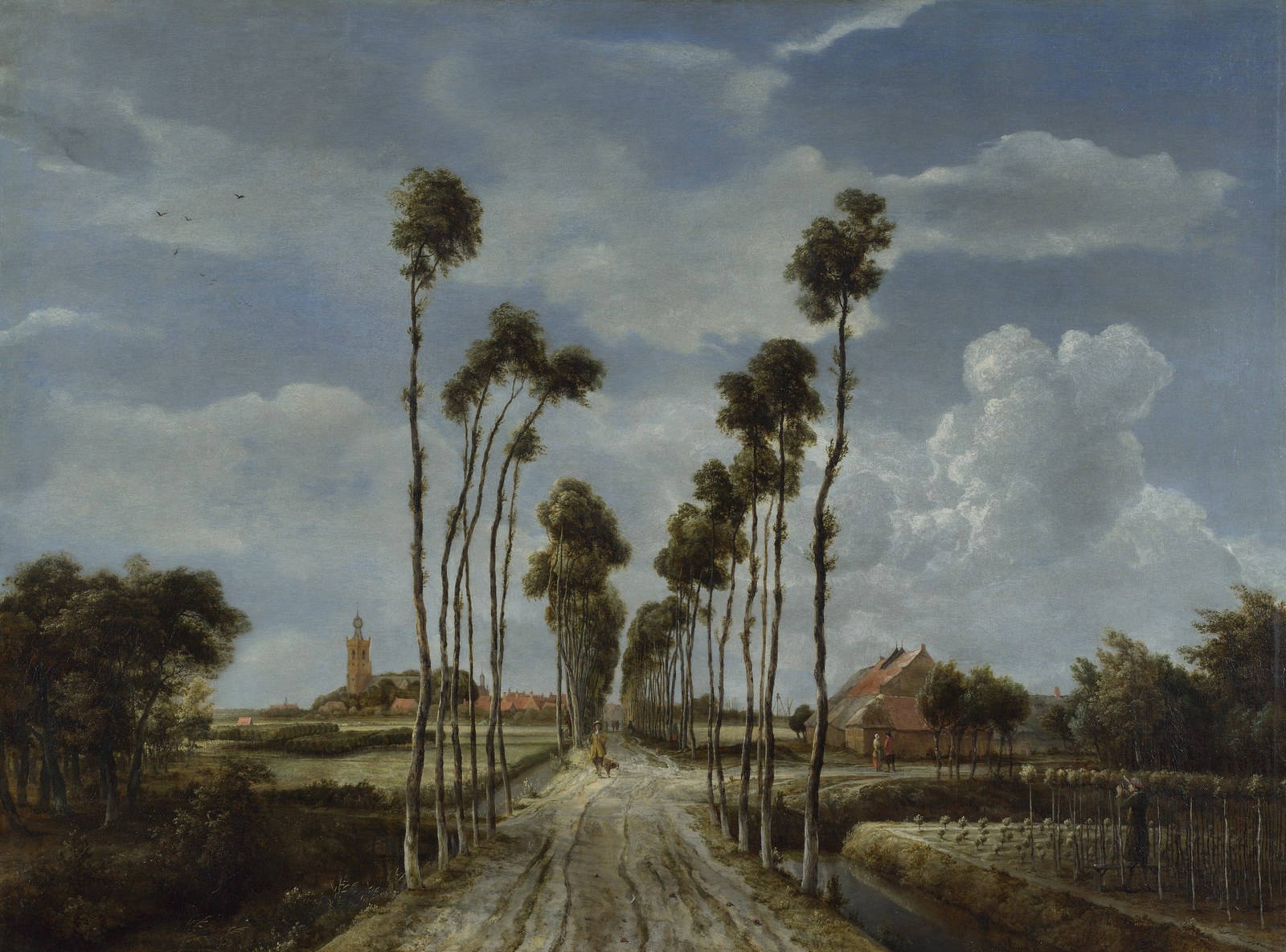
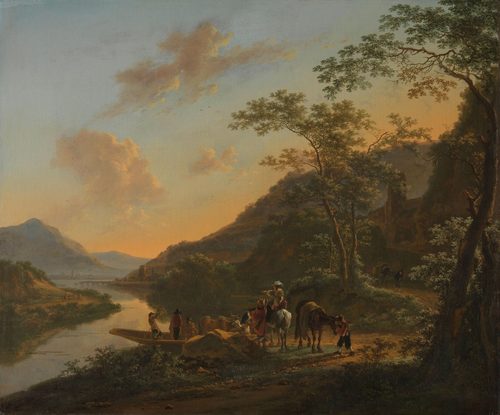
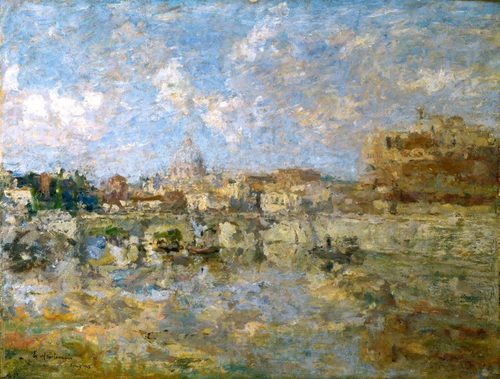
Leading lines are the lines within a composition, actual or implied, that guide a viewer's eye toward a focal point. They can be literal marks: a road narrowing toward the horizon, railway tracks converging in the distance, a river bending through a valley, a row of trees marching toward a vanishing point. They can also be implied, built from a figure's gaze, a beam of light, or a row of gestures all pointing the same direction. Straight lines that converge, as they do under linear perspective, create a strong pull toward a single vanishing point and a clear sense of depth. Diagonal leading lines feel energetic and unstable compared to calm horizontals or verticals, while gentle S-curves lead the eye on a slower, more leisurely path through a scene. Painters have used the device since the codification of linear perspective in the fifteenth century, and photographers adopted the same term explicitly once the camera made converging real-world lines impossible to ignore.
How artists use it
Converging avenue
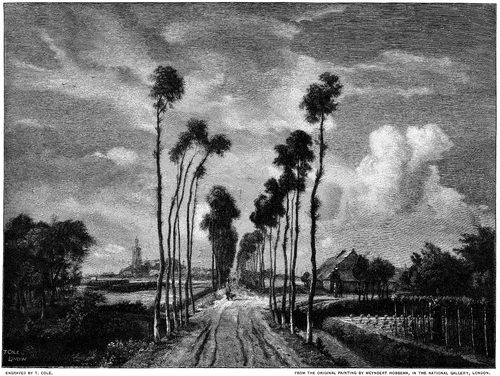
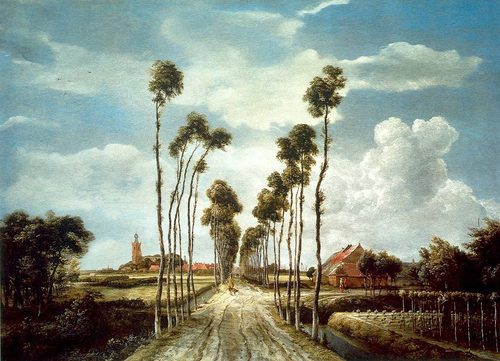
A straight road or row of trees narrowing toward a single vanishing point on the horizon pulls the eye deep into a landscape almost automatically, a technique Dutch landscape painters relied on to give flat, low-lying terrain a convincing sense of distance.
Diagonal dynamism
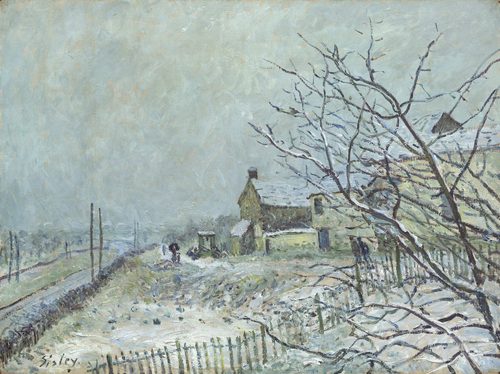
A leading line placed on a diagonal rather than a horizontal reads as more urgent and unstable, useful for railway tracks, bridges, or storm-lit landscapes where the artist wants motion and tension rather than a calm, settled feeling.
The S-curve river
A winding river or path that bends gently in an S-shape leads the eye on a slower, more leisurely journey through a landscape than a straight line does, a favorite device of nineteenth-century American landscape painting to suggest vast, unhurried space.
Architectural framing lines
Doorways, arches, and hallways create leading lines through architecture itself, funneling the eye through a literal frame within the frame toward a figure or view positioned at the far end, a device common in both interior painting and street photography.
Radiating lines
Lines that spread outward from a single point, rays of light, spokes of a wheel, cracks in a surface, work in reverse of converging lines, drawing attention back toward their shared origin and making that point the composition's unmistakable anchor.
Implied gaze lines
A figure looking off toward the edge of the canvas creates an invisible line the viewer's eye follows without any drawn mark at all, letting an artist point at an important detail using attention alone rather than pigment or ink.
Instant examples
Leading Lines in famous works, fast
- A road receding to the horizon
- → narrowing lines pull the eye from the foreground straight back into deep space toward a single vanishing point.
- Railway tracks converging in the distance
- → parallel steel rails appear to meet far ahead, a classic photographic example of forced perspective and depth.
- A river curving through a valley
- → a gentle S-curve leads the eye on a slower path through a landscape than a straight line would.
- A row of trees lining an avenue
- → evenly spaced trunks shrink in size as they recede, converging toward a distant focal point on the horizon.
- A hallway or staircase in perspective
- → architectural edges converge to frame and funnel the eye toward whatever waits at the far end.
- A diagonal fence line crossing the foreground
- → an angled line cuts across the composition, adding energy and pulling the eye toward the background.
The story
Leading lines became a deliberate tool once linear perspective was formalized in early fifteenth-century Florence, credited to architect Filippo Brunelleschi's experiments and codified in Leon Battista Alberti's 1435 treatise Della Pittura, which explained how converging lines toward a single vanishing point could fake convincing depth on a flat surface. Dutch seventeenth-century landscape painters, including Meindert Hobbema, used straight roads and avenues of trees to put that mathematics to atmospheric use. Nineteenth-century Romantic and Hudson River School painters favored winding rivers and paths instead of rigid straight lines, letting curves lead the eye more gently through vast scenery. Once photography matured in the nineteenth and twentieth centuries, the term "leading lines" entered common use as an explicit compositional rule, taught alongside the rule of thirds in art schools and photography courses ever since.
The canonical examples
| Work | Artist | Date | Why it matters |
|---|---|---|---|
| The Avenue at Middelharnis | Meindert Hobbema | 1689 | a row of tall trees lining a straight road converges sharply toward a vanishing point on a flat, distant horizon |
| The Oxbow | Thomas Cole | 1836 | the winding bend of the Connecticut River curves through the composition, leading the eye across the valley below |
| Rain, Steam and Speed – The Great Western Railway | J. M. W. Turner | 1844 | the diagonal railway bridge and track lead the eye directly toward the oncoming train's indistinct, blurred form |
| Paris Street; Rainy Day | Gustave Caillebotte | 1877 | converging cobblestone lines and sharply angled building edges lead the eye toward the intersection's vanishing point |
| The Great Wave off Kanagawa | Katsushika Hokusai | c. 1831 | the curling, claw-like lines of foam lead the eye downward from the crest toward the small boats below |
 AI-generated
Try it yourself
Practice leading lines with AI
This example was generated from a prompt like: “A straight dirt road flanked by bare, leafless trees, receding sharply toward a single point on a flat horizon at dusk, muted orange sky, long shadows stretching across the road, empty and quiet, high contrast.”
Open the Leading Lines Art Style generator →The concept today
Photography tutorials treat leading lines as one of the first rules taught, with landscape and street photographers actively hunting for converging roads, tracks, and fences before framing a shot. Cinematographers stage hallway and road shots specifically to pull a viewer's attention toward a character or reveal. Graphic designers use directional cues, arrows, gaze, and diagonal edges, to steer eyes toward a call-to-action button in ads and apps, applying the same centuries-old device to a screen instead of a canvas.
Compose your own
Find a photograph with a road, fence, or river in it, and crop the frame so the line enters from a bottom corner rather than the center, strengthening its pull. Practice drawing a simple one-point perspective grid, then sketch a hallway or street scene directly along its converging lines. Try replacing a horizontal leading line with a diagonal one in the same composition and compare how much more energetic the diagonal version feels. Finally, experiment with implied lines only, no drawn line at all, by having a figure's gaze or a beam of light point toward your intended focal point.
Frequently asked questions
What are leading lines in art?
Leading lines are lines within a composition, either drawn or implied, that direct a viewer's eye toward a focal point, such as a road narrowing toward the horizon or a figure's gaze pointing toward an important detail.
What's the difference between leading lines and linear perspective?
Linear perspective is the mathematical system of converging lines meeting at a vanishing point to create the illusion of depth. Leading lines is the broader compositional habit of using any line, converging or not, to guide attention.
Can implied lines count as leading lines?
Yes. A figure's gaze, a beam of light, or a row of pointing gestures can lead a viewer's eye just as effectively as an actual drawn or photographed line, even though no mark connects the two points directly.
Why do diagonal leading lines feel more dynamic than horizontal ones?
Diagonal lines break the calm stability of a horizontal or vertical line, suggesting motion or imbalance. That extra visual tension is why railway tracks, storms, and action scenes so often rely on diagonal composition.