 Art
Art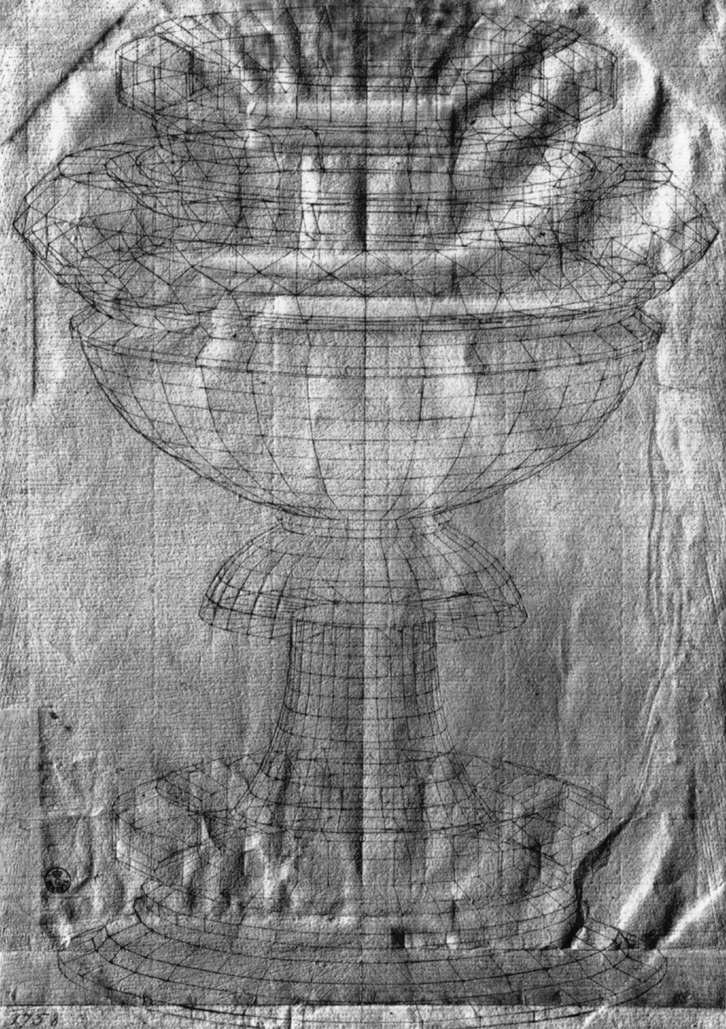
Perspective in art is a set of techniques for making a flat surface look like it has real depth, for making distant things appear smaller, closer things appear larger, and parallel lines appear to converge toward the horizon. Before the Renaissance, most painting used size to show importance rather than distance, so a king might tower over peasants regardless of where he stood in the scene. Linear perspective changed that by giving artists a mathematical system: one or more vanishing points on the horizon line that every receding line in the picture points toward, exactly the way railroad tracks appear to meet in the distance. Atmospheric perspective works alongside it, using haze, softened detail, and cooler, paler color to push far-off mountains and skies back in space. Together these tools let painters build convincing rooms, streets, and landscapes on a flat panel. Perspective isn't the only way to show depth, since overlapping shapes, shifting scale, and even deliberately wrong perspective have all been used for effect, but it remains the foundational geometry behind most realistic image-making, from Renaissance frescoes to video game engines.
How artists use it
One-point convergence
Da Vinci's The Last Supper aligns every line in the room, its ceiling beams, walls, and table, so they converge on a single vanishing point placed directly behind Christ's head, using geometry to make him the picture's inevitable focus.
Architecture that centers a figure
Raphael's The School of Athens uses a deep, receding archway built on one-point perspective to frame the two central philosophers exactly at its vanishing point, layering architecture and figures into one continuous system.
Atmospheric depth
Friedrich's Wanderer above the Sea of Fog fades distant mountain ridges to pale blue-gray through layers of haze, using color and softened edges instead of converging lines to show how far the peaks recede.
Anamorphic distortion
Holbein's The Ambassadors includes a skull stretched diagonally across the foreground that only resolves into a recognizable shape when viewed from an extreme side angle, turning perspective itself into a hidden trick.
Impossible perspective
Escher's Relativity stacks multiple contradictory vanishing points and directions of gravity into one architecture, breaking the rules of perspective on purpose to build a space that could never physically exist.
Elevated, bird's-eye view
Bruegel's Hunters in the Snow views an entire village from a high, distant vantage point, using a steep downward angle and shrinking scale to lay a whole landscape out almost like a map.
Instant examples
Perspective in famous works, fast
- The Last Supper
- → every architectural line converges on a single vanishing point behind Christ's head.
- The School of Athens
- → a deep receding archway centers the two philosophers at its vanishing point.
- Wanderer above the Sea of Fog
- → distant ridges fade to pale blue-gray, showing depth through haze rather than lines.
- The Ambassadors
- → a skull stretched diagonally across the foreground only resolves when viewed from the side.
- Relativity
- → staircases and doorways combine contradictory vanishing points into one impossible space.
- Hunters in the Snow
- → a high, distant vantage point lays a whole village out like a map.
- The Ideal City
- → a textbook one-point scene where every tile and cornice recedes toward a single vanishing point.
The story
For most of history, artists showed depth with overlap and relative size rather than geometry, since Egyptian and medieval art often scaled figures by importance, not distance. Filippo Brunelleschi is credited with formally working out linear perspective in early-1400s Florence, demonstrating that a scene could be constructed mathematically from a single viewpoint. Leon Battista Alberti wrote down the rules soon after, and Renaissance painters like Raphael and da Vinci adopted one-point perspective as a near-universal standard for architecture and interiors. Northern European painters developed atmospheric perspective alongside it, using color and clarity to suggest distance in landscapes. By the 1800s, photography made accurate perspective automatic, freeing painters to distort it deliberately: Cubists fractured single-viewpoint space entirely, and later artists like Escher built impossible perspectives purely as visual puzzles. Today linear perspective is a default assumption in cameras, 3D software, and game engines rather than a discovery.
The canonical examples
| Work | Artist | Date | Why it matters |
|---|---|---|---|
| The Last Supper | Leonardo da Vinci | 1495–98 | every line converges on a single point behind Christ |
| The School of Athens | Raphael | 1509–11 | a receding archway centers the two philosophers at its vanishing point |
| Wanderer above the Sea of Fog | Caspar David Friedrich | 1818 | distant ridges fade through haze to show depth without lines |
| The Ambassadors | Hans Holbein the Younger | 1533 | a stretched skull only resolves from an extreme side angle |
| Relativity | M.C. Escher | 1953 | staircases combine impossible, contradictory vanishing points |
| Hunters in the Snow | Pieter Bruegel the Elder | 1565 | a high vantage point lays the whole village out like a map |
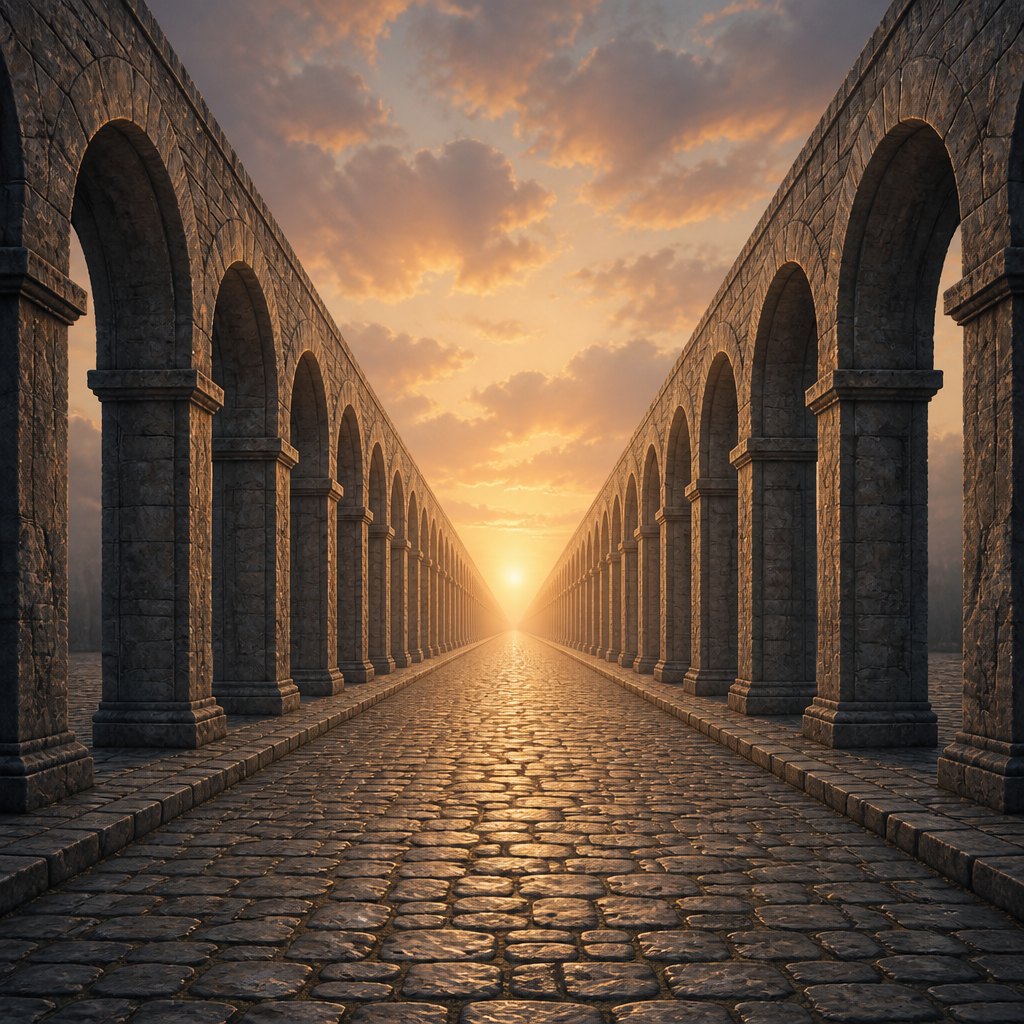 AI-generated
Try it yourself
Practice perspective with AI
This example was generated from a prompt like: “An empty cobblestone street lined with identical stone archways on both sides, all receding toward a single glowing vanishing point on the horizon, with the arches shrinking evenly in size the farther back they go.”
Open the Quattrocento Perspective Renaissance Art Style generator →The concept today
Camera lenses reproduce linear perspective automatically, which is why wide-angle shots exaggerate converging lines and telephoto lenses flatten them. Film directors choose lens length partly to control how aggressive that convergence feels. 3D software, architectural renders, and video games are built entirely on vanishing-point math, just calculated instead of hand-drawn. UI designers use scale and drop shadows to fake depth on a flat screen. AI image generators handle standard one- and two-point perspective well from a simple prompt, but tend to struggle with consistent, physically accurate vanishing points across a busy scene.
Compose your own
Pick a horizon line first: it sits at your eye level, wherever that is in the scene. Choose one vanishing point on that line for a straight-on view, or two points for a corner view, and let every parallel line that recedes into the distance angle toward one of those points. Keep close objects larger and more detailed, and shrink and simplify objects as they move back in space. For landscapes, push distant elements toward paler, cooler, hazier color to suggest atmosphere between the viewer and the horizon. Overlap shapes so nearer ones partly cover farther ones, since it reads as depth even without any converging lines at all. Check your work by tracing a few receding lines back to confirm they actually meet.
Frequently asked questions
What are examples of perspective in art?
Leonardo da Vinci's The Last Supper converges every line on a point behind Christ, Raphael's The School of Athens centers philosophers in a receding archway, and Caspar David Friedrich's Wanderer above the Sea of Fog uses haze instead of lines to show distance.
What's the difference between linear and atmospheric perspective?
Linear perspective uses converging lines and a vanishing point to show depth geometrically. Atmospheric perspective uses paler color, less contrast, and softer detail to suggest how far away something is, especially in landscapes.
What is a vanishing point?
It's the point on the horizon line where parallel lines receding into the distance appear to meet, the same way railroad tracks look like they converge far away.
Who invented linear perspective?
Architect Filippo Brunelleschi is credited with formally working out linear perspective in early-1400s Florence; Leon Battista Alberti wrote down the rules shortly after for other artists to use.