 Art
Art

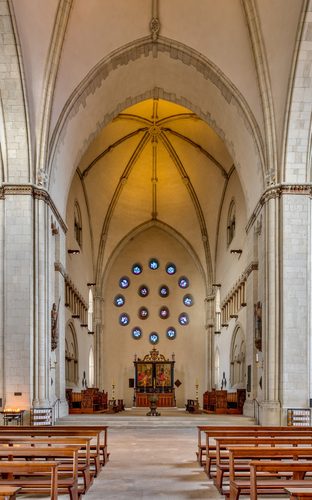

Symmetry in art is a balanced correspondence between parts of a composition, most commonly a mirror image across a central axis, so one half closely reflects the other. Bilateral symmetry mirrors left and right around a vertical line, the kind found in a human face or a classical building facade. Radial symmetry arranges elements around a central point so they repeat outward in every direction, like petals around a flower's core or spokes on a wheel. Translational symmetry repeats a motif at regular intervals along a line, as in a repeating architectural molding or a length of patterned fabric. Symmetry reads as formal, stable, and calm, since a mirrored composition satisfies the eye's expectation almost instantly, requiring little effort to parse. That same predictability is also symmetry's limitation: used everywhere, it can feel static or rigid, which is why artists often pair a symmetrical structure with one asymmetrical detail to keep a composition from feeling too perfectly resolved. Symmetry appears constantly across architecture, religious art, and design, wherever a sense of order, authority, or sacred stability is the goal.
How artists use it
Mirrored down the center
Leonardo da Vinci's Vitruvian Man mirrors a human figure's limbs precisely around a central vertical spine inside a circle and square, making bilateral symmetry both the drawing's structure and its literal subject.
A mandala's radiating order
Tibetan sand mandalas build outward from a single central point in perfectly repeating rings of pattern, and that radial symmetry gives the whole design a sense of cosmic, meditative order regardless of which direction it's viewed from.
A cathedral facade mirrored
The west facade of Notre-Dame Cathedral in Paris mirrors its twin towers, rose window, and portals precisely around a central axis, and that architectural symmetry projects institutional stability and sacred order to anyone approaching the building.
Symmetry broken on purpose
Grant Wood's American Gothic sets up a near-symmetrical composition — two figures, a peaked window — but shifts small details slightly off-center, and that subtle break in perfect symmetry keeps the formal, mirrored pose from feeling stiff or lifeless.
Petals around a core
Georgia O'Keeffe's Black Iris arranges the flower's petals so they radiate outward evenly from a central point, and that radial symmetry gives the close-up composition a sense of calm, organic order rather than chaos.
A repeating decorative band
Islamic geometric tilework, seen throughout the Alhambra palace, repeats a single interlocking module at regular intervals across entire walls, and that translational symmetry builds an intricate pattern that feels endlessly ordered no matter how far it extends.
Instant examples
Symmetry in famous works, fast
- Vitruvian Man
- → symmetry — a figure's limbs mirror precisely around a central vertical spine
- Notre-Dame Cathedral facade
- → symmetry — twin towers, a rose window, and portals mirror around a central axis
- Black Iris
- → symmetry — petals radiate evenly outward from a central point
- American Gothic
- → symmetry — a near-mirrored pose is broken by small off-center details to avoid stiffness
- Alhambra tilework
- → symmetry — a single module repeats at regular intervals across an entire wall
- Tibetan sand mandalas
- → symmetry — pattern radiates outward in repeating rings from one central point
The story
Ancient and religious art leaned heavily on symmetry to project order, authority, and the sacred, mirroring temple facades and altar compositions around a central figure or axis. Classical Greek and Roman architects treated symmetry as near-mathematical law, using it across column spacing, pediments, and whole building plans. Byzantine and Islamic traditions developed intricate radial and translational symmetry in mosaics and tilework, partly because geometric pattern could stand in for figurative imagery where it was restricted. Renaissance artists and architects revived classical symmetry deliberately, using it to signal harmony between the human body, architecture, and divine order. By the 19th and 20th centuries, artists increasingly treated strict symmetry as old-fashioned or rigid, favoring asymmetrical balance for a livelier feel, though modernist architects and designers later returned to symmetry for its clarity, using it selectively rather than as a default rule.
The canonical examples
| Work | Artist | Date | Why it matters |
|---|---|---|---|
| Vitruvian Man | Leonardo da Vinci | c. 1490 | look at how the limbs mirror precisely around a central vertical line |
| Notre-Dame de Paris (west facade) | Gothic architects, unknown | 1163-1345 | look at how the twin towers and rose window mirror around the central portal |
| Black Iris | Georgia O'Keeffe | 1926 | look at how the petals radiate evenly from a central core |
| American Gothic | Grant Wood | 1930 | look at the near-mirrored pose broken by small off-center details |
| Taj Mahal | Ustad Ahmad Lahauri (attributed) | 1632-1653 | look at how the mausoleum, minarets, and gardens mirror perfectly around a central axis |
 AI-generated
Try it yourself
Practice symmetry with AI
This example was generated from a prompt like: “A single white lotus flower viewed directly from above, its petals radiating in perfect symmetry from a golden center, floating alone on the still, mirror-flat surface of a dark pond.”
Open the Perfect Symmetry Art Style generator →The concept today
Architects and product designers still reach for symmetry when a design needs to feel stable, trustworthy, or formal, from a courthouse facade to a centered logo. Photographers use reflections in water or glass to build spontaneous symmetry within a single frame. UI designers apply symmetry to centered layouts and modals to signal focus and importance, while intentionally breaking it elsewhere to keep a page from feeling static. AI image generators handle symmetry unevenly, often struggling with strict bilateral symmetry in faces or objects, which is why symmetrical prompts sometimes need extra guidance to render cleanly.
Compose your own
Decide which type of symmetry fits your composition: bilateral for a calm, formal mirror down one axis, radial for a design that should feel centered and self-contained, or translational for a repeating decorative band. Establish a clear central axis or point first, then build outward, checking that matching elements on each side are truly equivalent in size, color, and position. Perfect symmetry can feel static, so consider breaking it in one small, deliberate spot, a slightly shifted detail or a single asymmetrical accent, to keep the composition from feeling lifeless. Symmetry works especially well when the goal is order, authority, or calm, so reserve it for compositions that want to feel resolved rather than dynamic or tense.
Frequently asked questions
What are examples of symmetry in art?
Leonardo da Vinci's Vitruvian Man mirrors a figure around a central spine; the Taj Mahal mirrors its dome and minarets around a central axis; and Georgia O'Keeffe's Black Iris uses radial symmetry, with petals radiating evenly from a central core.
What's the difference between symmetry and balance?
Symmetry is a specific, precise mirroring of parts around an axis or point. Balance is broader — it's the sense that visual weight is evenly distributed, which can be achieved through symmetry or through asymmetrical arrangements of different elements that still feel equally weighted.
What are the types of symmetry in art?
The main types are bilateral symmetry, mirroring left and right around a vertical axis; radial symmetry, repeating elements outward from a central point; and translational symmetry, repeating a motif at regular intervals along a line, as in decorative patterns.
Why do artists sometimes break symmetry on purpose?
Perfect symmetry can feel static or rigid, so artists often introduce one small asymmetrical detail into an otherwise mirrored composition. That subtle break keeps the formality of symmetry while adding enough visual interest to stop the piece from feeling lifeless or overly predictable.