 Art
Art
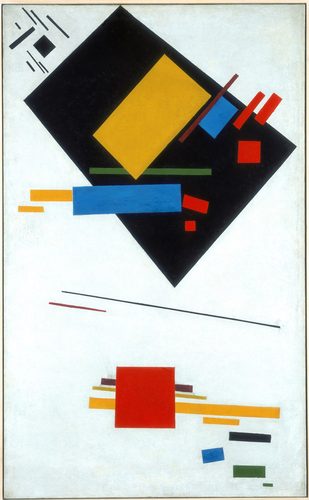
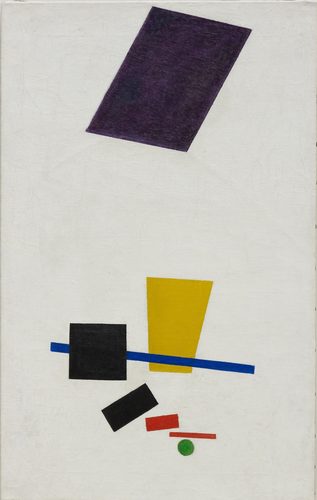
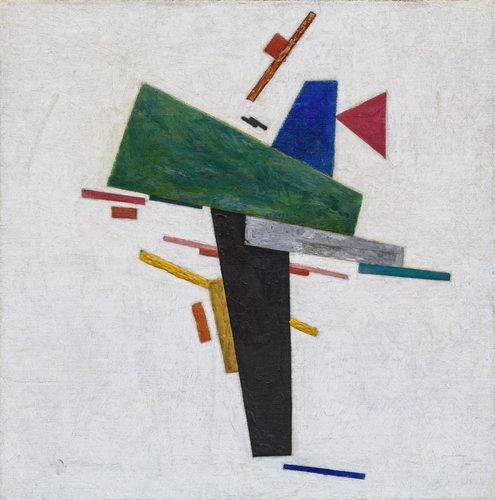
An abstract shape is any area on a picture plane that doesn't represent a recognizable object — a shape valued for its own size, edge, and placement rather than for what it depicts. Abstract shapes fall into two broad families: geometric shapes, built with rulers and compasses into crisp squares, circles, and triangles, and organic or free-form shapes, with irregular curved edges that feel loose and hand-drawn. Because an abstract shape carries no subject to read, artists lean entirely on its size, color, edge quality, and position relative to other shapes to create rhythm, tension, or balance. A large flat square can feel stable and grounded; a tilted triangle can feel like it is about to fall. Abstract shape became the central subject of painting itself in the early twentieth century, when artists such as Wassily Kandinsky and Kazimir Malevich decided that shape, color, and composition no longer needed to serve a recognizable image at all.
How artists use it
Suprematist reduction
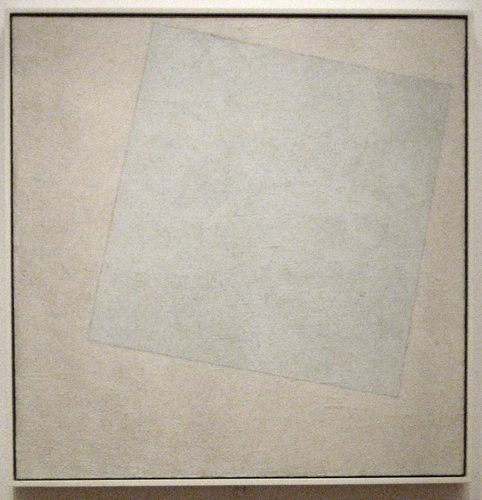
Kazimir Malevich reduced painting to a single black square floating on a white ground in Black Square, presenting pure geometric shape as an endpoint rather than a design element. It stands as art history's starkest claim that shape alone could be a complete artwork.
Composition as music
Wassily Kandinsky arranged circles, triangles, and crossing lines across Composition VIII according to their felt weight and tension rather than any depicted scene, treating each shape the way a composer treats a musical note or chord.
Grid and primary blocks
Piet Mondrian and the De Stijl group flattened composition into rectangular blocks divided by thick black lines and filled only with red, yellow, blue, or white, insisting shape and color needed no reference to the visible world to carry meaning.
Diagonal dynamism
Theo van Doesburg tilted the De Stijl grid forty-five degrees in his Counter-Composition series, arguing that diagonal geometric shapes created more visual dynamism than Mondrian's strict horizontals and verticals ever could.
Constructivist geometry
El Lissitzky's Proun paintings stacked flat geometric shapes into illusionary three-dimensional architecture, treating abstract shape as a blueprint for a new, non-representational visual world tied to Constructivist ideals.
Cut-paper abstraction
Sophie Taeuber-Arp arranged cut colored-paper squares and rectangles into strict grid compositions, showing that abstract shape could be constructed by hand-cut collage as precisely as it could be painted or ruled.
Instant examples
Abstract Shapes in famous works, fast
- Malevich's Black Square
- → reduction — a single flat geometric shape presented as the endpoint of representational painting.
- Mondrian's colored grid
- → order — rectangles bounded by black lines and filled only with primary colors and white.
- Kandinsky's floating circles and triangles
- → musicality — shapes arranged for felt rhythm rather than any depicted subject.
- Bauhaus geometric posters
- → clarity — flat circles, triangles, and squares used as a universal, teachable visual language.
- De Stijl red-yellow-blue design
- → abstraction beyond canvas — the same flat geometric shapes applied to chairs, buildings, and print.
- Constructivist Proun compositions
- → architecture — stacked geometric shapes suggesting three-dimensional structures without depicting real buildings.
The story
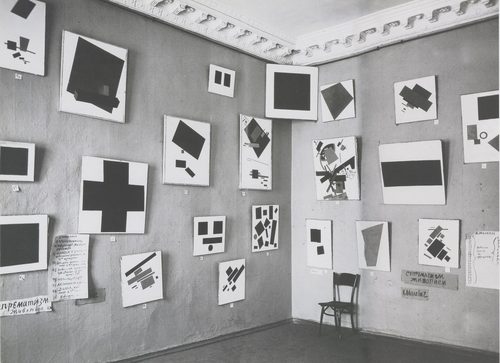
Wassily Kandinsky is often credited with among the first fully non-representational watercolors, made around 1910–13 in Munich, as he pushed color and shape away from any recognizable subject. Kazimir Malevich went further at the 1915 '0,10' exhibition in Petrograd, unveiling Black Square and launching Suprematism, a movement built on the fewest possible geometric shapes. In the Netherlands, Piet Mondrian and Theo van Doesburg founded the De Stijl movement and magazine in 1917, reducing composition to grids of rectangles and primary colors. Germany's Bauhaus school, founded in 1919, taught geometric abstraction as a design discipline under instructors including Kandinsky and Josef Albers. Meanwhile in Russia, Constructivists such as El Lissitzky and Alexander Rodchenko treated abstract shape as a tool for building a new visual and social order through the 1920s.
The canonical examples
| Work | Artist | Date | Why it matters |
|---|---|---|---|
| Black Square | Kazimir Malevich | 1915 | a single flat black square on a white ground, first shown at the '0,10' exhibition as the founding image of Suprematism |
| Composition VIII | Wassily Kandinsky | 1923 | circles, a triangle, and crossing lines are arranged for internal balance and tension rather than any depicted scene |
| Broadway Boogie Woogie | Piet Mondrian | 1942–43 | small colored squares of red, yellow, and blue march along a grid of yellow lines, evoking rhythm without depicting a place |
| Counter-Composition V | Theo van Doesburg | 1924 | a grid of flat geometric planes is tilted forty-five degrees off the horizontal-vertical axis of classic De Stijl work |
| Proun 99 | El Lissitzky | c. 1924–25 | geometric shapes are stacked and angled to suggest three-dimensional architectural forms in flat abstract space |
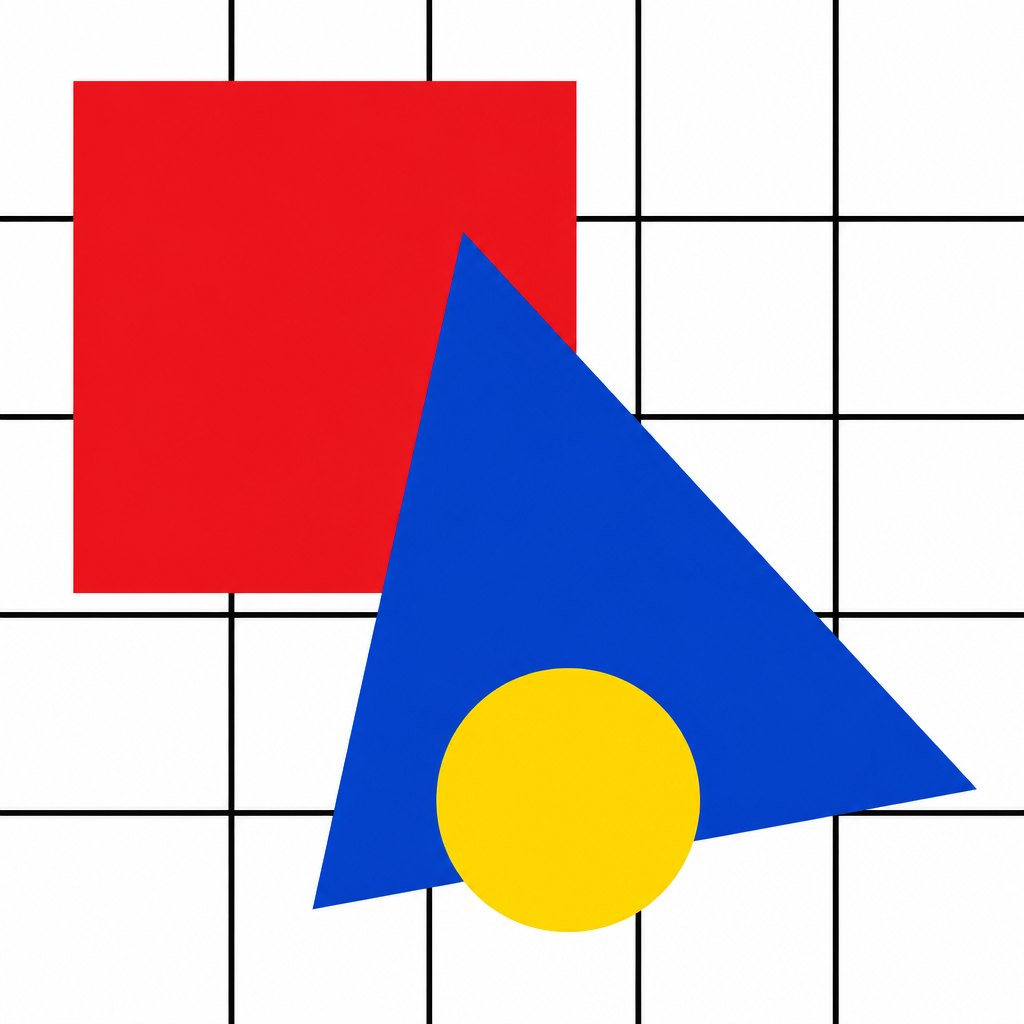 AI-generated
Try it yourself
Practice abstract shapes with AI
This example was generated from a prompt like: “A flat composition of overlapping geometric shapes — a large red square, a tilted blue triangle, and a small yellow circle — arranged on a white canvas with thin black grid lines, minimalist, high contrast, poster-flat color.”
Open the Abstract Shapes Art Style generator →The concept today
Flat design and material design interfaces on phones and websites rely on the same vocabulary as early geometric abstraction: solid circles, rounded rectangles, and simple triangles used for instant clarity. Corporate logo design regularly strips a brand down to a single abstract geometric mark. Generative artists now code algorithms that arrange abstract shapes according to rules, echoing Kandinsky's and Mondrian's search for compositions built on pure form and color rather than depiction.
Compose your own
Cut simple geometric shapes from colored paper and rearrange them on a page until the composition feels balanced without depicting anything at all. Try assigning emotional weight to basic forms: a circle reads as soft, a triangle as tense, a square as stable, then build a small composition testing that theory. Draw a grid of thick black lines like Mondrian's and fill only a few cells with color, leaving the rest white, to see how sparse color placement changes balance. Finally, take a recognizable photograph and simplify it into five or six flat geometric shapes, removing all detail until only pure shape remains.
Frequently asked questions
What is an example of abstract shape in art?
Kazimir Malevich's Black Square is a classic example — a single flat black square on white with no representational content. Mondrian's grid paintings and Kandinsky's Composition VIII are other well-known examples of purely abstract shape.
What's the difference between abstract shapes and geometric shapes?
Geometric shapes are a type of abstract shape built with precise, ruled edges like circles and squares. 'Abstract shape' is the broader category, also including irregular, free-form organic shapes that don't represent an object.
Who started using abstract shapes in painting?
Wassily Kandinsky's non-representational watercolors around 1910–13 and Kazimir Malevich's 1915 Suprematist works are usually cited as the first paintings built entirely from shape and color with no recognizable subject.
What is the difference between abstract shapes and biomorphic shapes?
Abstract shapes are any non-representational forms, geometric or organic. Biomorphic shapes are specifically the organic, curved, life-inspired subset of abstraction, contrasted with hard-edged geometric abstraction like Mondrian's grids.