 Art
Art
Geometric shapes are precise, mathematically definable forms — circles, squares, triangles, and their variations — with clean edges and consistent, describable proportions. In art, geometric shapes read as ordered, stable, and deliberate, because they rarely occur in nature by accident and almost always signal human intention: architecture, tools, machinery, and design. A square or triangle in a composition feels planned in a way an irregular blob doesn't, which is why geometric shapes dominate art movements interested in structure, rationality, or the modern built environment, from Renaissance perspective grids to 20th-century abstraction. Different geometric shapes carry different associations: circles suggest completeness, movement, or the infinite; squares and rectangles suggest stability and solidity; triangles suggest tension, direction, or hierarchy depending on which way they point. Painters use geometric shape both literally, to depict buildings, windows, or objects, and abstractly, stripping a composition down to pure shape relationships with no recognizable subject at all. Because geometric forms are so legible and repeatable, they're also the backbone of design systems, from Renaissance architecture to modern logos, wherever clarity and order matter more than organic variety.
How artists use it
The circle as harmony
Leonardo da Vinci's Vitruvian Man inscribes a human figure inside both a circle and a square, using the two geometric forms to argue that ideal human proportion follows mathematical law. The shapes aren't decoration — they're the entire argument of the drawing.
Squares stacked into a grid
Piet Mondrian's Composition with Red, Blue and Yellow reduces painting to a grid of black lines and rectangles, with no curve or diagonal anywhere in the canvas. The rigid geometry was deliberate, meant to strip painting down to universal, impersonal order.
Triangles that stabilize a scene
Raphael's The School of Athens organizes dozens of figures into a stable triangular composition beneath a series of receding architectural arches. The underlying geometric structure keeps a crowded, complex scene from feeling chaotic.
Cubism breaks form into facets
Georges Braque's Houses at l'Estaque flattens an entire hillside village into stacked, angular cubes and triangles, abandoning realistic modeling for pure geometric structure. The painting helped launch Cubism, a movement built almost entirely on fracturing form into geometric facets.
Circles as pure movement
Wassily Kandinsky's Several Circles arranges overlapping disks of varying size and color across a dark field, using the circle alone to suggest rhythm, motion, and cosmic scale. No other shape appears — the composition is an argument for what a single geometric form can do.
Architecture as geometric subject
Charles Sheeler's American Landscape renders an industrial factory complex as a set of clean, hard-edged geometric planes, with barely a curve in sight. The precise geometry mirrors the machine-made subject itself, turning architecture into the painting's actual content.
Instant examples
Geometric Shapes in famous works, fast
- Vitruvian Man
- → circle and square together argue that ideal human proportion follows mathematical law
- Composition with Red, Blue and Yellow
- → a grid of black lines and rectangles reduces painting to pure geometric order
- The School of Athens
- → a hidden triangular composition keeps dozens of figures feeling stable, not chaotic
- Houses at l'Estaque
- → a hillside village flattened into stacked cubes helped launch Cubism
- Several Circles
- → overlapping disks alone suggest rhythm and cosmic motion with no other shape
- American Landscape
- → an industrial complex rendered in hard-edged planes mirrors its machine-made subject
The story
Geometric shape has anchored Western art since antiquity, when Greek architecture and sculpture were built on strict proportional systems believed to mirror natural, even divine, order. The Renaissance formalized geometry further, with linear perspective turning the picture plane itself into a grid of converging, calculable lines and artists like Leonardo da Vinci treating circle and square as keys to ideal human proportion. In the early 20th century, Cubism broke represented objects into geometric facets, and movements like De Stijl and Constructivism pushed further, using pure geometric shape — grids, rectangles, circles — with no recognizable subject at all, treating shape itself as the content. Industrial and architectural subjects in the same period, captured by Precisionist painters, mirrored the geometry of modern buildings and machines. Geometric abstraction remains a core thread in design and art education today.
The canonical examples
| Work | Artist | Date | Why it matters |
|---|---|---|---|
| Vitruvian Man | Leonardo da Vinci | c. 1490 | circle and square used to argue ideal human proportion |
| Composition with Red, Blue and Yellow | Piet Mondrian | 1930 | a grid of rectangles with no curve or diagonal |
| The School of Athens | Raphael | 1509-11 | a hidden triangular arrangement stabilizing dozens of figures |
| Houses at l'Estaque | Georges Braque | 1908 | a village flattened into stacked geometric cubes |
| Several Circles | Wassily Kandinsky | 1926 | overlapping disks used for pure rhythm and scale |
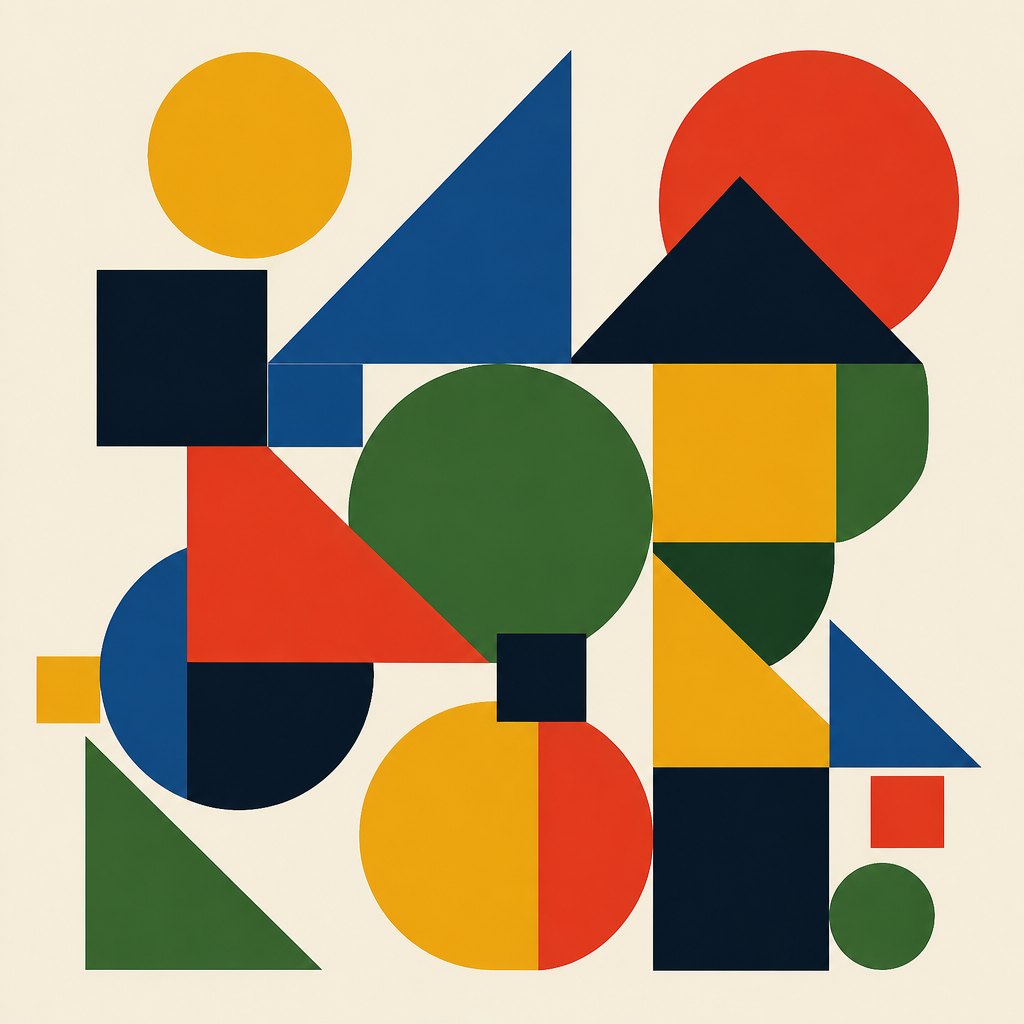 AI-generated
Try it yourself
Practice geometric shapes with AI
This example was generated from a prompt like: “An arrangement of overlapping circles, squares, and triangles in flat solid colors on a plain background, edges crisp and precise, sizes varying but all shapes aligned to an invisible grid — a pure study in geometric composition.”
Open the Suprematism Art Style generator →The concept today
Modern architecture and product design lean heavily on geometric shape for the same reasons painters do: clarity, order, and a sense of intention. UI design is built almost entirely from geometric shape — rectangles, circles, grids — because clean edges scan faster than irregular forms. Logo design favors simple geometric marks for the same reason; a circle or triangle reads instantly at any size. AI image generators handle geometric prompts precisely, since shapes like 'grid of squares' or 'concentric circles' are unambiguous instructions in a way organic, irregular forms rarely are.
Compose your own
Start with one dominant shape family — circles, squares, or triangles — and repeat it at different sizes rather than mixing all three, since consistency is what reads as order. Use a grid, even a loose one, to align edges and give scattered elements a shared structure. Triangles pointing in a consistent direction create implied motion or hierarchy, while a triangle used for stability should sit flat-side-down. Circles work well for a single focal point, since the eye locks onto them faster than other shapes. If a composition feels stiff, pair a geometric field with one irregular element to keep it from feeling purely mechanical. In AI prompts, name the specific shape and arrangement, like 'grid of overlapping circles,' rather than the general term 'geometric.'
Frequently asked questions
What are examples of geometric shapes in art?
Leonardo da Vinci's Vitruvian Man uses circle and square to define proportion, Piet Mondrian's Composition with Red, Blue and Yellow is built from a rectangle grid, and Georges Braque's Houses at l'Estaque flattens a village into cubes — all geometric-shape landmarks.
What is the difference between geometric and organic shapes?
Geometric shapes have precise, mathematically describable edges — circles, squares, triangles — and read as ordered and human-made. Organic shapes are irregular and free-form, like leaves or clouds, and read as natural and unplanned.
What do triangles usually mean in a composition?
Depending on orientation, tension, direction, or stability. A triangle resting flat-side-down feels solid and grounded, which is why classical paintings often arrange figures into a stable triangular grouping, as in Raphael's The School of Athens.
Why do artists use geometric shapes instead of realistic forms?
To emphasize order, structure, or the human-made world over natural irregularity. Movements like Cubism and De Stijl pushed this furthest, using geometric shape as the entire subject rather than a tool for depicting something else.