 Art
Art

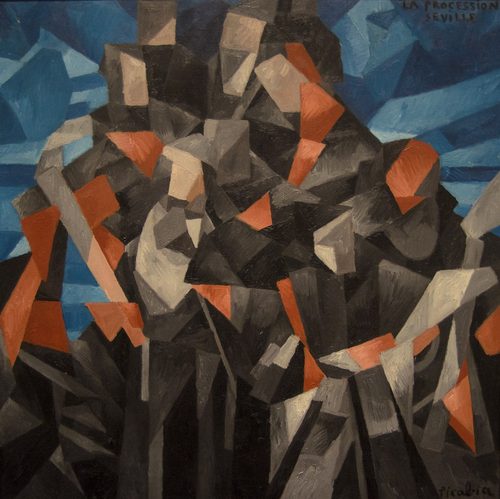
Dynamic composition is any arrangement built to feel like it's in motion rather than at rest. Where a stable composition leans on horizontals and verticals for calm, a dynamic one leans on diagonals, curves, and spirals that pull the eye rapidly through the picture. Artists tilt figures off their vertical axis, angle limbs and weapons across the frame, and let drapery, smoke, or hair stream sideways as if caught mid-gust to imply speed even in a static medium. Diagonal lines read as inherently unstable to the eye, which is exactly the point: they generate tension and urgency that a level horizon line cannot. Compositions can be built as a rising or falling diagonal pyramid, a radiating burst from one point, or a spiral that drags the viewer's gaze around and upward, as ceiling frescoes often do. Because dynamic composition works against the picture's natural stability, it is the tool of choice whenever an artist wants a scene to feel like a single frozen instant of something violent, urgent, or joyously energetic, rather than a settled, permanent state.
How artists use it
Diagonal pyramid
Théodore Géricault built The Raft of the Medusa around a steep diagonal pyramid of bodies rising from the dead and dying at lower left toward the one survivor waving cloth at upper right, driving the viewer's eye upward through despair toward faint hope.
Windswept implied motion
The Winged Victory of Samothrace shows drapery clinging and rippling against the figure's body as if pushed by wind, and a forward-leaning stance on a ship's prow, so a motionless marble figure reads as caught mid-stride against a gust.
Futurist lines of force
Umberto Boccioni filled The City Rises with swirling diagonal brushstrokes and a rearing, straining horse tangled among laborers, translating the frantic energy of urban construction directly into the painting's compositional structure.
Baroque diagonal thrust
Peter Paul Rubens arranged The Raising of the Cross along a steep diagonal, with straining men hauling the cross and Christ's body up and across the panel, so the entire composition physically strains against gravity.
Illusionistic spiral
Andrea Pozzo's ceiling fresco Apotheosis of Saint Ignatius uses painted architecture that appears to spiral upward beyond the real ceiling into an illusionistic sky, pulling the viewer's gaze in a dizzying diagonal rush toward a vanishing point.
Radiating diagonal recession
Tintoretto set his version of The Last Supper on a table receding sharply into deep diagonal space rather than facing the viewer head-on, replacing the Renaissance's calm frontal symmetry with sudden, theatrical spatial energy.
Instant examples
Dynamic Composition in famous works, fast
- Diagonal banner or flag in battle scenes
- → urgency — a tilted banner across the frame signals chaos and forward charge rather than calm order.
- Wind-blown drapery on sculpture
- → implied motion — fabric that clings and ripples suggests a figure caught mid-stride against the wind.
- Zigzag figure arrangement
- → instability — bodies staggered along a jagged path pull the eye rapidly through a scene of struggle.
- Spiraling ceiling fresco architecture
- → ascension — painted columns and figures twist upward, dragging the viewer's gaze toward a vanishing point.
- Radiating burst lines
- → explosive energy — lines fanning out from one point mimic light, sound, or sudden impact.
- Rearing horse pose
- → frantic motion — a horse caught mid-rear injects violent unpredictability into an otherwise still image.
The story
Dynamic composition has ancient roots: Hellenistic sculptors abandoned the calm stances of earlier Greek art for twisting, wind-caught figures, as in the Winged Victory of Samothrace, carved around 190 BCE. The Baroque period, beginning around 1600, made diagonal drama a house style, with painters like Rubens and Tintoretto and ceiling fresco specialists like Andrea Pozzo replacing Renaissance stillness with sweeping diagonals and illusionistic spirals meant to overwhelm the viewer physically. Romantic painters carried the diagonal pyramid into the early 19th century, most famously in Géricault's The Raft of the Medusa of 1818–19, turning composition itself into emotional argument. Italian Futurism made dynamism explicit doctrine: its 1910 manifesto demanded art capture speed and force directly, and Umberto Boccioni's The City Rises, painted that same year, translated urban energy into swirling diagonal brushwork before his early death in 1916.
The canonical examples
| Work | Artist | Date | Why it matters |
|---|---|---|---|
| The Raft of the Medusa | Théodore Géricault | 1818–19 | bodies rise in a steep diagonal pyramid from the dead at lower left toward the signaling survivor at upper right |
| Winged Victory of Samothrace | Unknown | c. 190 BCE | wind-caught drapery and a forward-leaning stance make a motionless marble figure read as striding into gusting wind |
| The City Rises | Umberto Boccioni | 1910 | swirling diagonal brushstrokes and a rearing horse translate urban construction energy directly into the composition |
| The Raising of the Cross | Peter Paul Rubens | 1610–11 | straining men haul the cross up along a steep diagonal that pulls the entire panel's composition against gravity |
| Apotheosis of Saint Ignatius | Andrea Pozzo | 1691–94 | illusionistic painted architecture spirals upward beyond the real ceiling toward a dizzying vanishing point |
 AI-generated
Try it yourself
Practice dynamic composition with AI
This example was generated from a prompt like: “A dramatic scene of robed figures straining along a steep diagonal to hoist a large wooden beam upward, wind-blown fabric streaming sideways, swirling dark storm clouds behind, dramatic chiaroscuro lighting, oil-painting style, no visible faces.”
Open the Dynamic Composition Art Style generator →The concept today
Dynamic composition drives contemporary visual storytelling wherever energy needs to read instantly: comic and manga panels use diagonal action lines and tilted 'Dutch angle' framing to signal chaos, film storyboards angle shots off-level for tension, and sports photographers wait for the exact peak of a leap or swing to freeze maximum diagonal energy. Video game concept artists still study wind-caught drapery and rearing-horse poses from centuries-old sculpture and painting to make static character art feel like it's mid-motion.
Compose your own
Sketch the same simple scene twice, once with a level horizon and calm upright figures, once tilted off-axis with figures staggered along a diagonal, and compare how differently each one feels before adding a single detail. Practice arranging three or more figures into a diagonal pyramid, weakest or lowest figure at one corner, strongest or highest at the opposite corner, the way Géricault structured the Raft of the Medusa. Study wind-blown drapery on classical sculpture and try drawing fabric clinging and rippling against a still pose to fake motion. Finally, try quick gesture drawings that capture only the peak instant of an action, like a leap's highest point, since that instant carries the most implied energy.
Frequently asked questions
What makes a composition dynamic rather than static?
A dynamic composition relies on diagonals, spirals, or off-balance arrangements that feel unstable and full of energy, while a static composition relies on horizontal and vertical lines that feel calm, settled, and permanent.
What is a famous example of dynamic composition in Baroque art?
Rubens's The Raising of the Cross, painted around 1610–11, arranges straining men and a diagonally rising cross so the entire composition physically strains against gravity, a hallmark of Baroque dynamic drama.
How did Futurist artists show movement in still paintings?
Futurists like Umberto Boccioni used swirling diagonal brushstrokes, blurred overlapping forms, and straining poses, most visibly in his 1910 painting The City Rises, to translate real motion and urban energy into a single static image.
What is a diagonal pyramid composition?
It's an arrangement where figures or forms rise or fall along a steep diagonal line from one corner of the picture to the other, as in Géricault's The Raft of the Medusa, driving the viewer's eye rapidly through the scene.