 Art
Art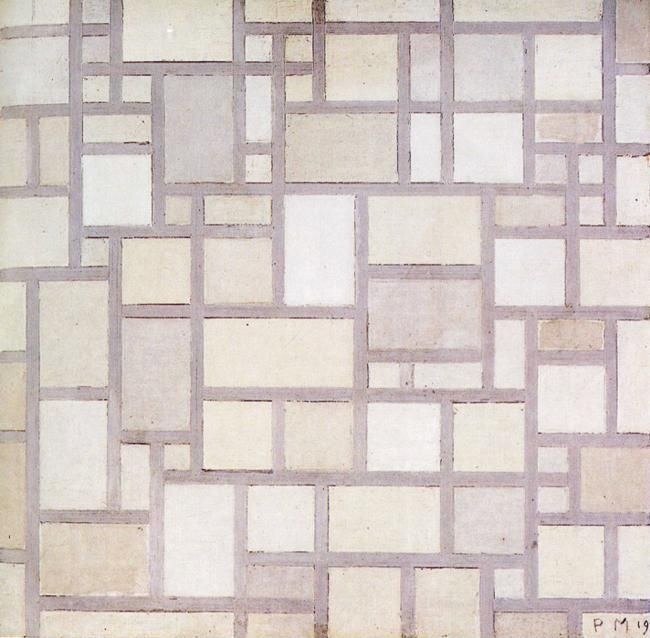
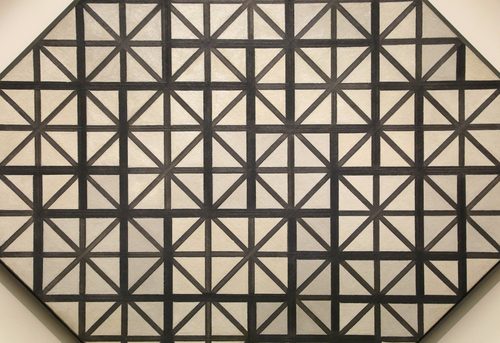
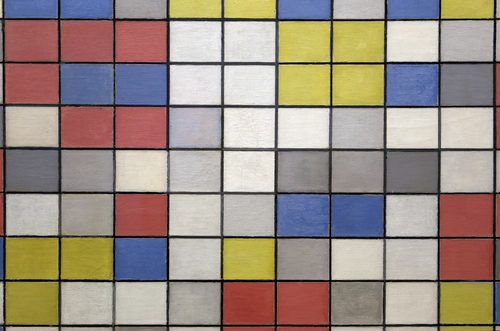
Grid composition arranges a picture around a lattice of horizontal and vertical (or evenly modular) divisions rather than around a single focal point. Sometimes the grid is the entire visible content, as in a canvas broken into flat colored squares; sometimes it's an invisible scaffold underneath a more naturalistic scene, guiding where forms are placed. Grids appear at every scale: a single canvas ruled into rectangles, a textile pattern built from repeating square blocks, or an ancient wall painting laid out over faint guideline squares to keep proportions consistent. Because a grid divides space into equal or related units, it produces a calm, orderly, almost architectural feeling — the opposite of a diagonal or spiraling composition. Artists also use grids as working tools rather than finished imagery: squaring up a small sketch onto a larger surface, or transferring a photograph onto canvas cell by cell. Whether visible or hidden, a grid gives a composition its underlying logic before a single color or figure is added.
How artists use it
Grid as street map
Piet Mondrian filled Broadway Boogie Woogie with a grid of intersecting black and gray lines dotted with small colored squares, deliberately echoing Manhattan's street grid and blinking traffic signals. The grid isn't background structure here — it is the entire subject.
Compartmentalized color grid
Paul Klee built Ancient Sound (Abstract on Black) from a checkerboard grid of individually colored squares, each cell shifting slightly in hue and tone like a separate musical note. The grid lets color do rhythmic, almost sonic work across the surface.
Guideline grid for proportion
Ancient Egyptian tomb painters, as seen in unfinished areas of the Tomb of Menna at Thebes, snapped faint red guideline grids onto walls before painting figures, using the squares to keep body proportions consistent across an entire composition.
Pieced textile grid
Traditional American Nine Patch quilts repeat one small pieced-square block across a strict grid to build a larger surface pattern, a construction method where the grid is both the design and the literal sewing structure holding the fabric together.
Grid transfer method
Artists preparing a mural or enlargement have long ruled a small sketch into a numbered grid, then ruled a matching but larger grid onto the final surface, copying each square one at a time to scale a composition up accurately without distortion.
Diamond-format grid
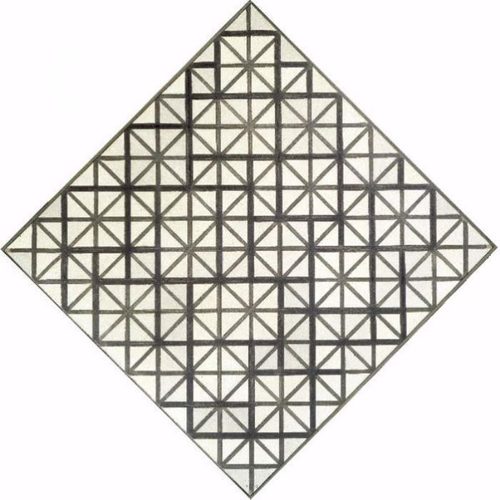
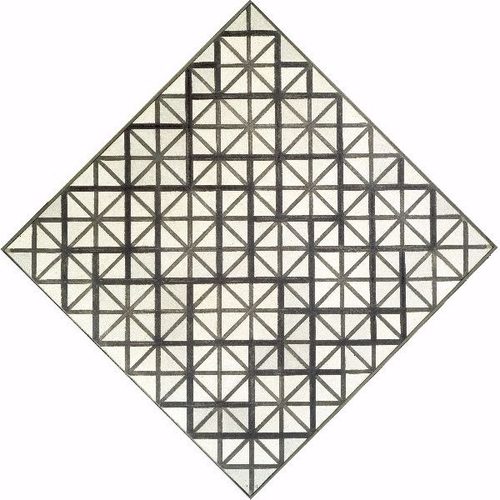
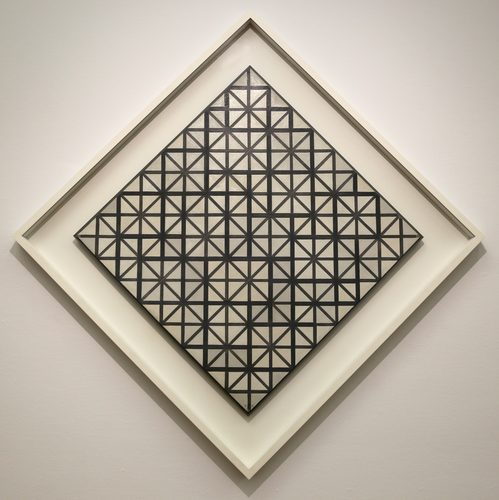
Piet Mondrian rotated a square canvas forty-five degrees in Checkerboard, Bright Colors, so a strict grid of colored squares reads as a diamond lattice rather than a rectangle, showing how orientation alone can make a grid feel new.
Instant examples
Grid Composition in famous works, fast
- Checkerboard floor tiles
- → spatial order — alternating squares establish a floor's depth and scale in perspective paintings.
- Quilt block patterns
- → modular construction — a repeating pieced square unit builds an entire larger textile surface.
- City street grid views
- → urban rhythm — a painted map of straight intersecting streets becomes abstract pattern from above.
- Comic book panel grids
- → sequential order — evenly divided rectangular panels pace a story frame by frame.
- Leaded stained-glass grid
- → structural lattice — metal grid lines both hold glass pieces in place and organize the image.
- Squared-up preparatory sketch
- → scaling tool — a numbered grid over a small drawing lets an artist enlarge it accurately by hand.
The story
Grids as a working method go back to ancient Egypt, where tomb and temple painters snapped guideline squares onto walls to keep figure proportions consistent, a practice visible in unfinished sections of tombs like Menna's at Thebes, around 1400 BCE. Roman and Islamic craftsmen used modular grids to plan mosaic and tile schemes centuries later, and European muralists adopted the 'squaring up' method to enlarge small studies onto walls and ceilings. The grid became a subject in its own right in the early 20th century: Piet Mondrian, associated with the De Stijl movement founded in the Netherlands in 1917, reduced painting to strict horizontal-vertical grids of color. Paul Klee, teaching at the Bauhaus from 1921, built canvases directly from grids of individually toned squares. By mid-century, grid-based thinking had spread from painting into modern graphic design and typography.
The canonical examples
| Work | Artist | Date | Why it matters |
|---|---|---|---|
| Broadway Boogie Woogie | Piet Mondrian | 1942–43 | a grid of intersecting lines dotted with small colored squares evokes Manhattan's street grid and traffic lights |
| Ancient Sound (Abstract on Black) | Paul Klee | 1925 | the canvas is divided into a checkerboard grid of individually colored and toned squares |
| Checkerboard, Bright Colors | Piet Mondrian | 1919 | a diamond-oriented canvas is filled edge to edge with a strict grid of flat colored squares |
| Nine Patch quilt | Unknown | 19th century, American | a repeating pieced-square block builds the entire quilt surface through a literal sewn grid |
| Guideline grid, Tomb of Menna | Unknown | c. 1400 BCE | faint red guideline squares, visible in unfinished wall sections, kept painted figures proportionally consistent |
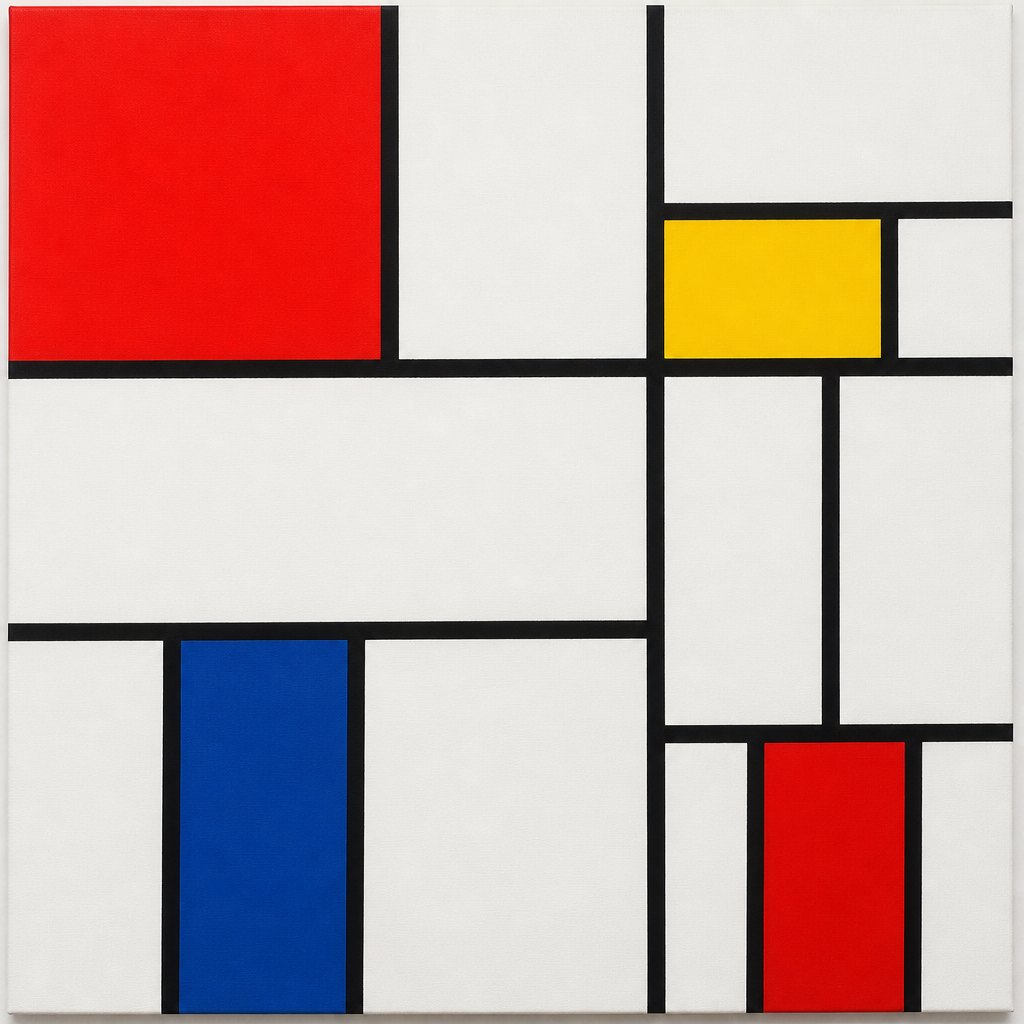 AI-generated
Try it yourself
Practice grid composition with AI
This example was generated from a prompt like: “A flat abstract painting divided by thick black lines into a grid of unequal rectangles, most left plain white, a few filled solidly with red, yellow, and blue, minimalist, high contrast, clean geometric studio photography of the canvas.”
Open the Grid Composition Art Style generator →The concept today
Grid composition now underlies most digital design: CSS grid and column systems structure websites, and Swiss-style graphic design principles from the mid-20th century still shape print and screen layout templates. Instagram profiles default to a three-column grid, and photographers plan feeds around it. Pixel art is built literally on a grid of individual squares. Spreadsheet and data-visualization tools present information in grids by default, the same organizing logic Mondrian turned into fine art a century ago.
Compose your own
Rule a faint pencil grid across your page before starting a composition, then place key elements only at grid intersections or along grid lines and see how much order that alone creates. Try a Mondrian exercise: divide a canvas with tape into unequal rectangles, then fill only two or three cells with flat primary color, leaving the rest white. Practice the squaring-up method by drawing a simple sketch inside a numbered grid, then copying it square by square onto a larger sheet with a matching but bigger grid. Finally, design one small pieced pattern block and repeat it across a grid to see how quilt-style construction builds a larger image from a single unit.
Frequently asked questions
What is grid composition in art?
Grid composition organizes a picture around a visible or implied lattice of horizontal, vertical, or modular divisions, using that structure to place forms, colors, or panels in an ordered, architectural way rather than around one focal point.
Why did Mondrian use a grid in his paintings?
Mondrian believed a strict grid of straight horizontal and vertical lines, filled with flat primary colors, expressed universal balance and order, stripping painting down to what he considered its purest structural essentials.
How is a grid used to enlarge or transfer a drawing?
An artist rules a small sketch into a numbered grid, then rules a larger matching grid onto the final surface, and copies the contents of each small square into its corresponding larger square to scale the image up accurately.
Is the rule of thirds the same as grid composition?
Not exactly — the rule of thirds is a loose 3x3 guide for placing a focal point, while grid composition uses the grid itself, visible or not, as the actual structural basis of the entire finished artwork.