 Art
Art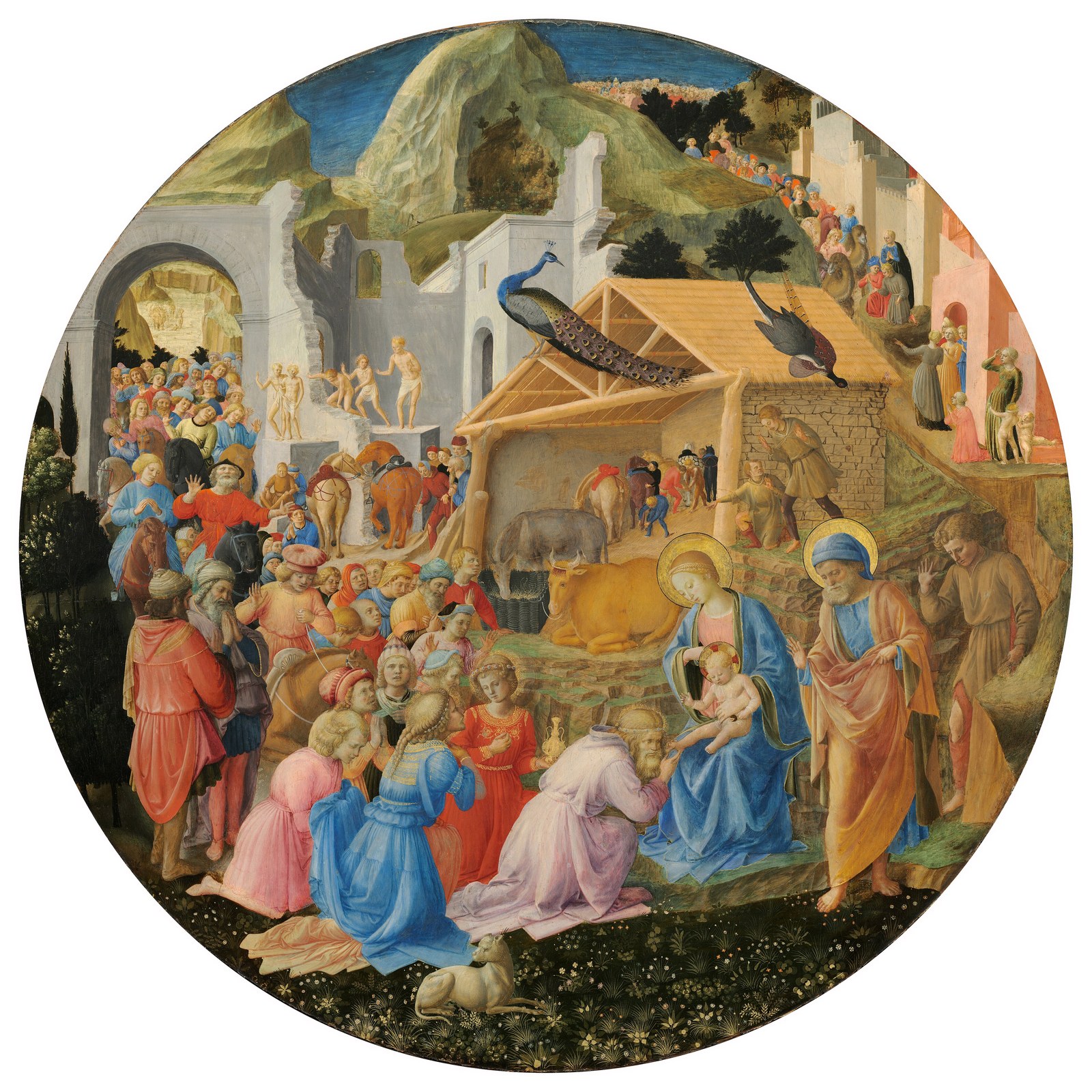
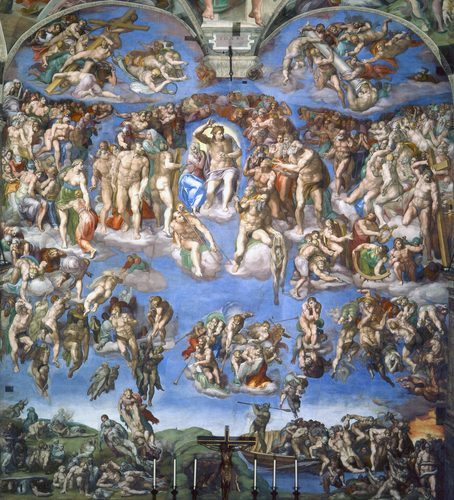
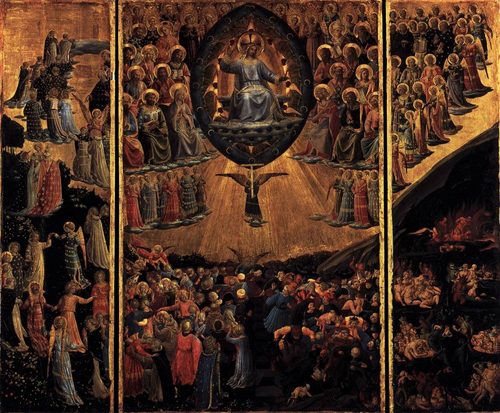
Hierarchy in art is the principle of ranking figures or elements by relative importance rather than by how they would actually appear in real space. The clearest form is hieratic scale: a pharaoh, saint, or ruler is drawn or carved noticeably larger than servants, soldiers, or worshippers standing right beside them, even though in life they would be the same height. Ancient Egyptian, Mesopotamian, and medieval Christian art relied on this constantly, because before the invention of linear perspective, artists had no consistent way to show depth, so they used size to show status instead. Hierarchy also works through placement: a figure set at the exact center, raised on a dais, or positioned above everyone else's eye line reads as more important even at equal scale. Color, isolation, and framing devices like a halo or throne reinforce the same message. Long after linear perspective made accurate scale possible, artists kept using hierarchy deliberately, because it communicates rank faster than realism ever could.
How artists use it
Hieratic scale
Egyptian relief and tomb painting carved the pharaoh or tomb owner far larger than servants and enemies standing in the same scene, regardless of actual distance or height. Size alone announced rank, a convention that lasted roughly three thousand years of Egyptian art.
Sacred enlargement
Byzantine icons and mosaics render Christ or the Virgin considerably larger than the surrounding saints and angels crowded around them. The disproportion is deliberate: divine figures occupy their own visual category, unbound by ordinary near-and-far logic.
Shrinking the donor
Netherlandish altarpieces often show the wealthy patrons who paid for the painting kneeling at the bottom edge, drawn noticeably smaller than the holy figures above them. Jan van Eyck used this in several commissions, letting scale humble the donor before the sacred scene.
Central throne
Court and religious art frequently places the most important figure at the exact center of the composition, often raised on steps or a throne so every other figure's gaze bends toward them. Placement does work that size alone sometimes cannot.
Tiered judgment
Last Judgment scenes stack the composition into zones: Christ enthroned and oversized at the top center, the saved arranged in orderly rows beneath him, and the damned crowded smaller and chaotically at the bottom. Vertical position and scale rank souls simultaneously.
Framing devices
Halos, mandorlas, and canopies act as hierarchy without changing size at all, circling only the figure the artist wants isolated from the crowd. A plain gold disc behind one head instantly separates the sacred from the merely present.
Instant examples
Hierarchy in famous works, fast
- Oversized pharaoh in tomb reliefs
- → the ruler's exaggerated size next to normal-scale servants signals divine or royal status, not actual height.
- Enthroned Madonna with tiny angels
- → Byzantine and early Italian panels enlarge the Virgin far beyond the surrounding attendant figures around her.
- Kneeling donor portraits
- → small praying patrons tucked into altarpiece corners show humility before the much larger holy figures above.
- Golden halo or mandorla
- → a glowing circle isolates one head or body from the crowd, marking sacred status without changing scale.
- Central raised throne
- → placing a ruler above and between flanking courtiers marks rank through position rather than size alone.
- Giant Christ atop Last Judgment scenes
- → Christ enthroned dwarfs the ranks of the saved and damned crowded in smaller registers beneath him.
The story
Hierarchy of scale appears wherever art needed to rank status before it could convincingly render depth. Egyptian tomb painting and relief, dating to the Old Kingdom around 2600 BCE, made the pharaoh or tomb owner consistently larger than everyone else in the same scene. Mesopotamian works like the Standard of Ur, around 2500 BCE, use the same trick to single out the king in a banquet procession. Byzantine mosaics carried the convention into Christian art, enlarging Christ and the Virgin against ordinary-scale saints. Medieval Western Europe kept hierarchic scale alive through the Romanesque and Gothic periods, even as classical proportion was largely forgotten. The Renaissance rediscovery of linear perspective in early fifteenth-century Florence, formalized by Leon Battista Alberti, gave artists a mathematical way to show real spatial depth, and consistent scale gradually replaced symbolic scale in ambitious painting. Yet hierarchy never disappeared; it moved into placement, lighting, and composition instead.
The canonical examples
| Work | Artist | Date | Why it matters |
|---|---|---|---|
| Narmer Palette | Unknown (Ancient Egyptian) | c. 3100 BCE | King Narmer is carved noticeably taller than the enemies he smites and the attendant behind him, establishing status through sheer scale |
| Standard of Ur | Unknown (Sumerian) | c. 2500 BCE | the king stands taller than every other figure and animal in the banquet register, his head breaking the top border of the panel |
| Santa Trinita Maestà | Cimabue | c. 1280–85 | the enthroned Madonna towers far above the ranks of angels and prophets stacked around and beneath her throne |
| Justinian Mosaic, Basilica of San Vitale | Unknown | c. 547 | Emperor Justinian stands centered and slightly larger than the clergy and soldiers flanking him on either side |
| Last Judgment, Scrovegni Chapel | Giotto di Bondone | 1306 | Christ enthroned at the top center dominates the entire wall, drawn far larger than the tiers of saved and damned below him |
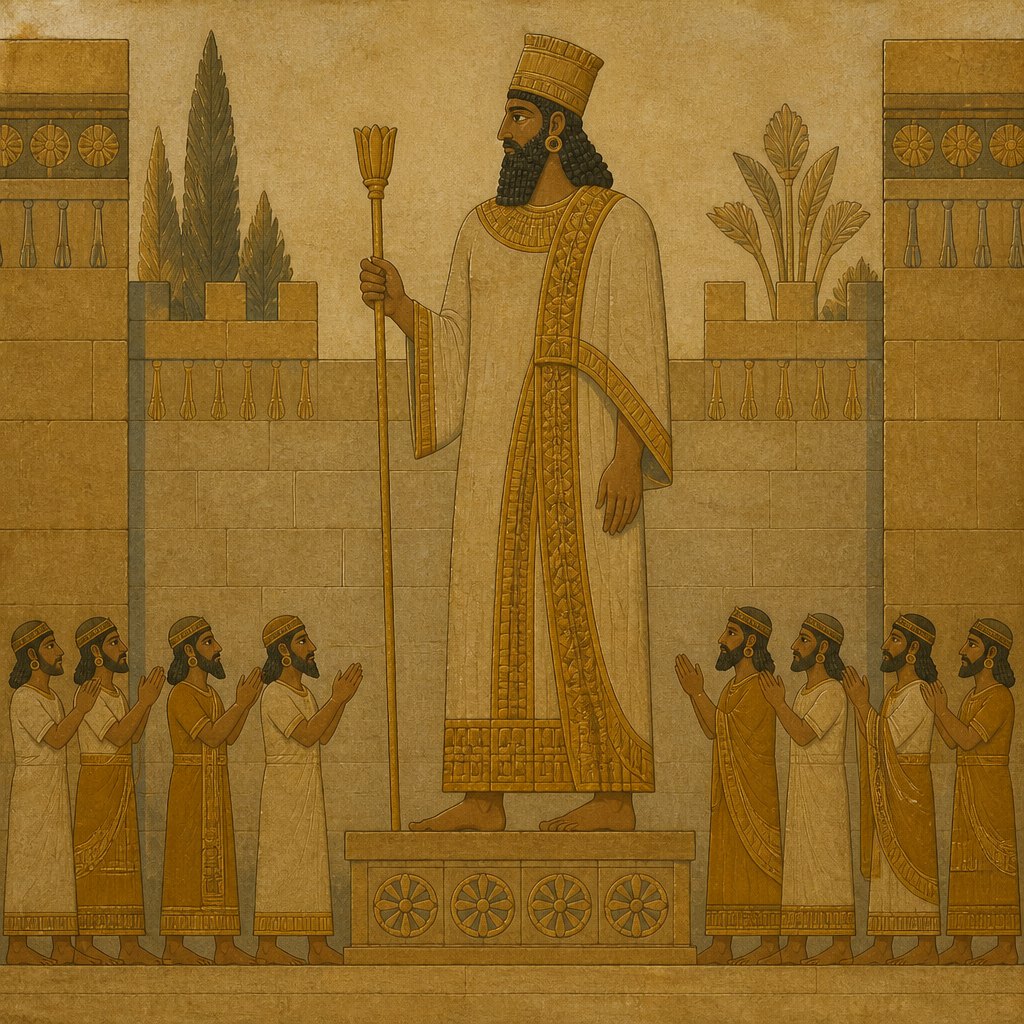 AI-generated
Try it yourself
Practice hierarchy with AI
This example was generated from a prompt like: “A stone courtyard scene where one robed figure stands twice the height of the surrounding attendants, centered on a raised platform, painted in flat ancient relief style with muted ochre and gold tones, clear hierarchy of scale, no shading.”
Open the Hierarchy Art Style generator →The concept today
Hierarchy of scale never left; it just changed vocabulary. Movie posters and comics still enlarge the lead character while shrinking supporting cast into the background. Corporate org charts and website navigation use size and top placement to signal seniority exactly like a medieval altarpiece. Infographics make the biggest number the biggest shape on the page. Video game UI enlarges a boss character and shrinks allies to signal threat instantly. Even social media profile grids subtly enlarge pinned posts, borrowing a visual language that is thousands of years old.
Compose your own
Practice hierarchy by drawing a simple scene — a classroom, a marketplace, a family dinner — and deliberately enlarge only the one figure you want viewers to notice first, keeping everyone else at a believable, smaller scale. Next, try the opposite: keep every figure the same size but move just one to dead center and raise them slightly higher, then compare how much weaker that version feels against your first sketch. Add a simple framing device, a circle of light or an arch, around your most important figure and note how much it reinforces the size cue. Finally, sketch a tiered composition like a Last Judgment, splitting the page into a large dominant zone and two or three smaller crowded zones beneath it, to feel how vertical stacking ranks importance on its own.
Frequently asked questions
What is hierarchy of scale in art?
It's a technique where figures are drawn larger or smaller based on their importance or status rather than their real physical size — a pharaoh, saint, or ruler shown bigger than servants or worshippers standing in the same scene.
Why did ancient Egyptian art use size instead of realistic proportion?
Egyptian artists had no system of linear perspective to show depth, so they used scale symbolically instead: the pharaoh or tomb owner was carved largest to signal rank, regardless of where they actually stood in the scene.
How is hierarchy shown without changing figure size?
Through placement and framing — putting a figure at the exact center, raising them on a throne or dais, or surrounding them with a halo or mandorla all signal importance even when every figure is drawn at the same scale.
Did hierarchy of scale disappear after the Renaissance?
Not entirely. Linear perspective made accurate scale possible, so most Renaissance painting moved toward realistic proportion, but artists still used composition, lighting, and central placement to rank importance, a habit that continues in film and design today.